Updated July 12, 2026 · 8 min read
The tub is gone; now there is a second decision hiding behind the first one — how the glass around the new shower gets framed, or doesn't. Framed, semi-frameless, and frameless enclosures are not just three looks. They use different glass thicknesses, different hardware, and land at genuinely different price points, and the choice affects the room's feel for as long as the glass stays in place.
This guide walks through what each style actually costs, what glass thickness buys you, and where a protective coating earns its keep — with an honest look at the moisture side of the decision, since a shower door in a marine climate has to do more than just look good.
Key takeaways
- Framed glass is the budget and simplest option ($300–$1,200 in materials); semi-frameless is the style-forward middle ground ($800–$1,300); frameless is the premium, cleanest look ($1,100–$5,000+).
- Frameless glass runs 3/8" or 1/2" thick — 3/8" is sufficient for most installations; 1/2" adds cost, weight, and break-resistance.
- A protective coating cuts spotting and cleaning time on both municipal water and private wells — worth adding on any enclosure style.
- Ventilation, not the glass, controls post-shower humidity — a fan sized to HVI/ASHRAE guidance (about 1 CFM per square foot) keeps the enclosure and surrounding wall from staying damp long enough to grow mildew.
- Frameless installation is precision work, and wall-blocking for a heavy door may need a local permit — correct hinge and wall support keeps the door leak-free and structurally sound.
Framed enclosures: the budget-friendly default
A framed enclosure surrounds every glass panel with a metal frame, which is what makes it the least expensive and easiest of the three styles to install. That frame isn't purely decorative — it does double duty as part of the water seal, and framed doors have a solid track record for leak resistance specifically because the frame backs up the gasket at every edge.
The compromise is visual: the metal border reads more traditional than an unbroken sheet of glass, and the tracks collect soap scum and standing water the way any framed system does. For a secondary bathroom, a rental unit, or a budget-conscious remodel, framed glass is still a perfectly sound choice — it just isn't the sleekest one.
Semi-frameless: the middle ground
Semi-frameless doors keep framing to a minimum — typically just the hinges, the wall connection, and occasionally one vertical support bar — so most of the glass surface reads clean while metal still carries some of the structural load. Material pricing sits between the other two styles, running $800–$1,300 versus a framed door's $300–$1,200.
It's the pick for a homeowner who wants a more contemporary look than a fully framed door delivers, without paying frameless prices or committing to the thickest, heaviest glass.
Frameless: what the thicker glass is actually doing
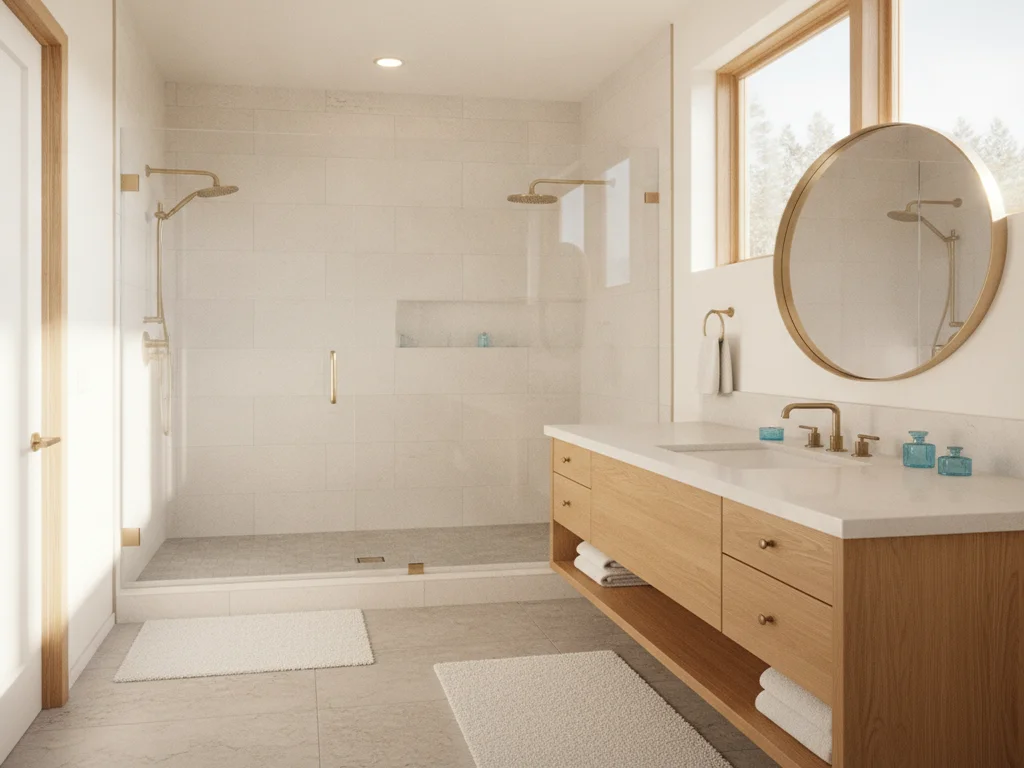
A frameless door has no metal frame at all — the glass itself carries the structural load, held in place by hinges, clamps, or a header. That structural role is exactly why frameless glass has to be thicker, and why frameless enclosures run $1,100 to $5,000+ in materials per This Old House.
Frameless glass typically comes in 3/8-inch or 1/2-inch thickness. Bob Vila's guidance is that 3/8-inch glass is sufficient for most frameless installations and easier to ship and install than the thicker option; 1/2-inch glass resists breaking better but costs more and adds enough weight that some installs need reinforced hinges or wall blocking to support it. This Old House prices the jump to 1/2-inch glass at an added $15–$58 per square foot over the base door.
Not a weekend DIY project
Bob Vila calls frameless-door installation "fairly complicated," and for good reason — precise measurements, adequate wall support, and correct hardware alignment all have to line up. Heavy frameless glass over an exterior wall may also need blocking that requires a permit from the City of Camas, City of Vancouver, or Clark County; check before starting.
Cost and complexity, side by side
| Style | Materials | Look | Install complexity |
|---|---|---|---|
| Framed | $300–$1,200 | Full metal frame; classic, most affordable | Simplest |
| Semi-frameless | $800–$1,300 | Framing only at edges; cleaner and more modern | Moderate |
| Frameless | $1,100–$5,000+ | No frame; thick glass on hinges or clamps; sleek | Most demanding |
Material ranges from This Old House (2026); labor and hardware finish add to the total, and a fully installed single door has averaged around $959 per This Old House. Larger custom frameless enclosures run well above that. Clark County sales tax (roughly 8.6–8.7%, per the Washington State Department of Revenue) applies to remodel labor and materials on top of these figures.
A protective coating pays for itself
Regardless of enclosure style, a protective glass coating is one of the better dollar-for-dollar upgrades on the list, and it matters whether your home is on municipal water or a private well. This Old House prices a water-spot-resistant coating at $4–$20 per square foot, with low-iron ("ultra-clear") glass adding $6–$15 per square foot on top of that.
EnduroShield, a manufacturer in this space, describes the coating as an ultra-thin transparent layer that repels water and oil-based residue the way a non-stick pan repels food — it keeps minerals and soap film from bonding to the glass in the first place, which is what drives both everyday spotting and long-term etching. Clark County tap water is not especially mineral-heavy, but plenty of homes further out, particularly toward Brush Prairie and other unincorporated parts of the county, run on private wells where mineral content varies house to house — the coating helps regardless of the source, since soap residue alone will spot untreated glass over time. EnduroShield's own TÜV Rheinland testing shows the coating performing beyond 10 years, backed by a 10-year limited warranty on new glass professionally applied (5 years on existing glass, 3 years for DIY kits).
The moisture problem a door alone can't solve
Even the best-sealed enclosure only controls water inside the shower; what happens to the humidity after the door opens is a ventilation question, not a glass question. The Home Ventilating Institute, drawing on ASHRAE 62.2 sizing guidance, recommends roughly 1 CFM of exhaust airflow per square foot of bathroom floor area, with 80–110 CFM fans common for bathrooms built around a larger frameless enclosure or a shower-tub combo. A fan that's undersized, or one that vents into an attic instead of outdoors, leaves the enclosure — and the drywall and grout around it — damp far longer than it should be, and the EPA notes mold and mildew can begin establishing within 24 to 48 hours of that kind of sustained dampness.
A frameless door with minimal hardware and fewer channels for water to hide in is actually the easier style to keep mildew-free for this reason, since there's less framing track to trap standing water between cleanings.
Coordinating hardware
Hinges, clamps, handles, and channels are sold separately from the glass itself and come in enough finishes to match whatever else is in the room. Manufacturers like CRL (C.R. Laurence) offer dozens of hinge and sliding-door hardware systems built specifically for shower glass, from brushed nickel to matte black, so the hardware doesn't have to be whatever ships default with the door. See our fixture and hardware finishes guide for how to coordinate that hardware with your faucet.
Frequently asked questions
- What is the difference between framed, semi-frameless, and frameless shower doors?
- Framed doors have a metal frame around every glass panel — the most affordable and simplest to install. Semi-frameless doors use minimal framing at the edges for a cleaner look at a moderate cost. Frameless doors use thick tempered glass with no metal frame at all, held by hinges or clamps, for the most modern look and the highest price.
- Should I choose 3/8-inch or 1/2-inch glass for a frameless shower door?
- 3/8-inch glass is sufficient for the majority of frameless installations and is easier to ship and install, per Bob Vila. 1/2-inch glass is more resistant to breaking and can look slightly more substantial, but it costs more (This Old House prices the upgrade at $15–$58 per square foot) and adds weight that may require reinforced hardware.
- Is a protective glass coating worth it for a shower enclosure?
- For most homeowners, yes. Coatings like EnduroShield create a non-stick barrier that keeps minerals and soap film from bonding to the glass, cutting cleaning time and slowing water-spot buildup, with manufacturer testing showing performance well beyond 10 years and warranties of 3–10 years depending on how it's applied. It helps on municipal water and is arguably even more useful on the well water many outlying Clark County homes rely on, since mineral content there varies house to house.
- Does ventilation matter more than the shower door itself for controlling moisture?
- In a lot of ways, yes. The door only manages water while the shower is running; the fan is what clears the humidity afterward. HVI/ASHRAE 62.2 guidance calls for roughly 1 CFM of exhaust per square foot of floor area, and an undersized or poorly vented fan lets moisture linger long enough for mold and mildew to begin forming — the EPA puts that window at 24 to 48 hours of sustained dampness.
Sources
- This Old House — Shower Glass Door Installation Cost
- Bob Vila — Best Frameless Shower Doors
- EnduroShield — Protective Coating for Shower Glass (manufacturer)
- CRL (C.R. Laurence) — Shower Hardware (manufacturer)
- Washington State Department of Revenue — Sales & Use Tax Rates
- Home Ventilating Institute — Certified Ratings & Sizing Guidance
- EPA — A Brief Guide to Mold, Moisture and Your Home
Claims and figures are drawn from the sources above and provided for general guidance; your project may vary. Photography is illustrative of design concepts. For a fixed price on your specific bathroom, request a free estimate.