
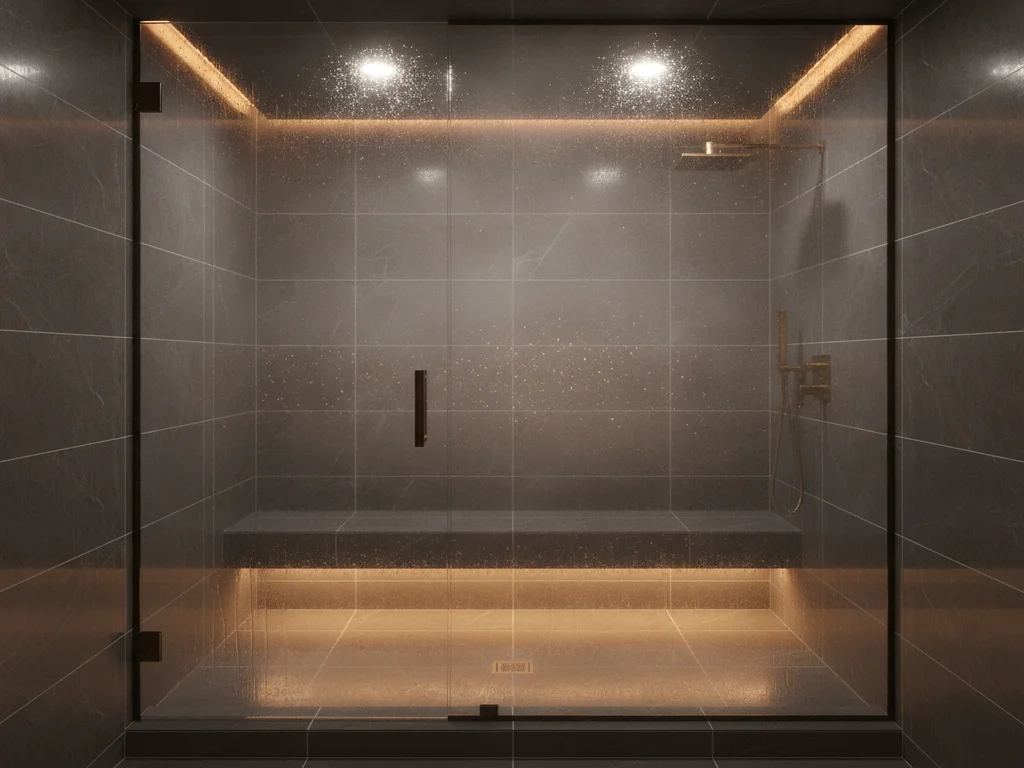
Steam Shower Installation
Priced to the scope of your room — fixed in writing after a free visit
Free in-home visit · Fixed written price · 1-year workmanship warranty
A steam shower turns an ordinary enclosure into a private spa — a vapor-sealed room that holds steam the way a commercial steam room does. Building one correctly is unforgiving work: every surface must be waterproofed and vapor-tight, sloped ceilings keep condensation off your shoulders, and the generator has to be sized to the cubic volume of the room. In a Marine 4C climate the sealing detail matters more than it does in a dry one, because vapor that escapes into a wall cavity here can stay there through months of damp weather before summer dries it.
What's included
Steam Shower Installation
- Steam generators sized to the enclosure and plumbed for service access
- Vapor-tight membranes behind every tiled surface, ceiling included
- Sloped ceiling design so condensation sheets to the walls, not on you
- Sealing detailed so vapor stays in the enclosure and out of the wall cavity
- Tight-sealing glass with transom, plus bench, aroma, and lighting controls within reach
How it works
Our steam shower installation process
The right choice for homeowners who want a genuine steam room at home and understand it is a sealed assembly rather than an accessory — the enclosure has to be built for it from the framing out.
- 1
Design & Sizing
The generator is sized to the cubic volume of the enclosure, not to the floor plan, and located where it remains accessible for service. Ceiling height, glass area, and material all change the calculation, so it is settled before construction.
- 2
Vapor-Proofing
Every tiled surface, ceiling included, is backed by a vapor-tight membrane. This is more demanding than standard shower waterproofing because steam drives vapor into any gap under pressure — and in Marine 4C, vapor that reaches a wall cavity can stay there through months of damp weather.
- 3
Tile & Controls
Tile is set over the sealed shell and the controls, aroma, and lighting are placed where you can reach them from the bench rather than from standing height. The ceiling is sloped so condensation sheets to the walls instead of dripping.
- 4
Glass & Commissioning
Tight-sealing glass with a transom for controlled venting goes in last. We run the system, confirm it holds steam and reaches temperature, and show you how to operate and maintain it.
What a steam shower costs
A steam shower is priced as an upgrade to a tiled shower you would be building anyway, so the useful number is what the steam system adds. Our steam shower cost guide collects the national figures: Fixr (2025) puts installation at $8,000–$15,000, averaging $11,000, across a full range of $3,800–$25,000. This Old House and Bob Vila report a lower average of roughly $4,300, with a typical range around $2,800–$7,100, because their figures lean toward simpler prefab units.
Mr. Steam (2022) offers a whole-project comparison: a sample 120-square-foot bathroom priced at $24,000 without steam came to $30,595 with it, roughly a 20–35% premium. Camas Bath builds steam as an upgrade to its Walk-In / Custom Tile Shower, published at $12,000–$22,000 on our pricing page; the cost calculator helps with the base shower number. Washington sales tax of roughly 8.0%–9.0% in Clark County, depending on the address, applies to labor and materials.
The cost drivers specific to steam are the generator (Bob Vila lists $500–$2,000, Fixr $400–$4,000 for larger enclosures), the size and finish of the enclosure that generator has to fill, whether the electrical panel can take a dedicated circuit, and options such as automatic flushing, aroma wells and in-shower controls.
| Type | Installed cost |
|---|---|
| Prefab steam shower | $2,800–$6,200 |
| Custom steam shower | $4,000–$10,000 |
| Prefab steam shower + tub combo | $4,000–$7,000 |
| Custom steam shower + tub combo | $6,000–$12,000 |
Source: Fixr (2025), as cited in our steam shower cost guide. National figures, before Washington sales tax.
Generator sizing, finishes and controls
Most of the design decisions trace back to one calculation. Steamist sizes generators by adjusted cubic footage: the enclosure's length times width times height, multiplied by a factor for the wall material. That makes finish choice a capacity choice, not just a look.
- Wall material: ceramic, porcelain or glass block multiplies the volume by 1.35; natural stone or marble by 2.0, so a stone enclosure needs roughly double the generator of a tiled one the same size.
- Exterior walls: one exterior wall adds a 1.1 factor, two add 1.2. Steam shower placement on an inside wall keeps the generator smaller.
- Ceiling height: Steamist suggests keeping the enclosure ceiling at 8 feet as a rule of thumb and no more than 10 feet, with factors of 1.15 at 9 feet and 1.3 at 10 feet. Lowering the ceiling over the enclosure keeps the generator size down.
- Example: This Old House notes a 4 by 5 by 8 foot (160 cubic foot) ceramic stall needs at least a 7 kW generator.
- Tile: larger-format porcelain or ceramic means fewer grout lines holding condensation; natural stone needs an impregnating sealer roughly every two years in steam conditions.
- Flushing: Mr. Steam AutoFlush drains the tank two hours after each use; without it, and without a whole-house softener, Mr. Steam advises a manual flush about every two months.
- Steamhead placement: steam leaves the head at around 212°F, so it should sit where feet and legs on the bench are out of its path.
Glass is safety glazing, not just glass
Federal rules (CPSC 16 CFR 1201) require shower doors and enclosures to be safety glazing meeting Category II, the 400 ft-lb impact test. Frameless enclosures typically use 3/8 or 1/2 inch tempered glass. See the shower door guide and, for the upkeep side, the steam shower maintenance guide.
Vapor control, ventilation, electrical and permits
Steam pushes vapor into gaps under heat, so the waterproofing behind a steam enclosure has to be vapor-tight as well as waterproof. This Old House describes two approaches: 6-mil plastic sheeting lapped at least one foot at the seams, or two coats of liquid polymer membrane (or a polyethylene sheet membrane) behind the stone or tile. Whatever the method, the membrane should carry an ANSI A118.10 rating and the shower should pass a flood test before tile; see shower waterproofing standards. Building Science Corporation warns against trapping a wall between two vapor barriers, so the rest of the wall assembly needs one direction it can dry toward, which our marine-climate moisture guide explains.
The bathroom outside the enclosure takes the moisture when the door opens. HVI's rule of about 1 CFM per square foot is the starting point, and our maintenance guide notes that bathrooms with a steam enclosure often warrant 80–110 CFM or more, ducted outdoors and run after every session. Sizing details are in the ventilation CFM guide.
Generators typically run on a dedicated 220–240V circuit, and in Washington electrical permits come from Washington L&I, except inside Vancouver city limits, where the city issues them. Under NEC 410.10(D), light fixtures inside the shower footprint need a damp or wet-location rating, and hanging fixtures are not allowed within 3 feet horizontally or 8 feet vertically of the threshold. Plumbing and building permits follow the rules in our Clark County permit guide. GFCI protection, the 20-amp receptacle circuit and outlet spacing for the rest of the room are in the bathroom electrical requirements guide.
Is a steam shower right for your home?
It makes sense if you will use it regularly, you are already building a fully tiled, glass-enclosed shower, and the bathroom has room for a generator where it can be reached for service. It also suits a primary suite where the shower is already the centerpiece; see master bathroom retreats.
The trade-offs are real. A steam enclosure needs a door that seals and a ceiling no higher than about 10 feet, so it rules out an open, doorless layout. It adds a generator to maintain, an electrical circuit, and a fan sized above the code minimum. Stone finishes roughly double the generator size, which raises cost.
If you want an open, step-free shower, a curbless shower or a wet room is the better match; neither holds steam. If the goal is simply a better everyday shower, a walk-in shower with good tile and glass delivers most of the experience without the sealed enclosure.
Good to know
Steam Shower Installation questions
- What electrical does a steam shower need?
- A dedicated circuit sized to the generator, which is why the electrical scope is settled during design rather than discovered at rough-in. Requirements vary by generator capacity, and the work is permitted and inspected as part of the project.
- How much maintenance does a steam shower require?
- Mostly draining the generator on the manufacturer schedule and keeping the enclosure wiped down. Mineral content in the water supply drives how often the generator needs attention — local groundwater carries dissolved minerals, and scale is the usual reason a neglected generator underperforms. Some units automate the flush.
- Will steam escape into the rest of the bathroom or house?
- Not if the enclosure is built as a sealed room, which is the whole point of the vapor-proofing stage. A tight-sealing door, a transom for controlled venting, and a full ceiling membrane keep steam in the enclosure. A steam unit installed in an ordinary shower is exactly how moisture ends up in the surrounding walls.
Steam Shower Installation by city
Steam Shower Installationin Vancouver, Camas & Clark County
Guides & ideas
Planning your steam shower installation project
Request a free estimate
Ready to start your steam shower installation bathroom project?
Tell us a little about your space and we'll follow up to schedule a free, no-obligation design consultation with clear, fixed pricing.
Prefer to talk? Call (360) 838-1340

Get Started Today
Ready to Transform Your Bathroom?
Let's create a space you'll love for years to come. Schedule a free consultation today.