
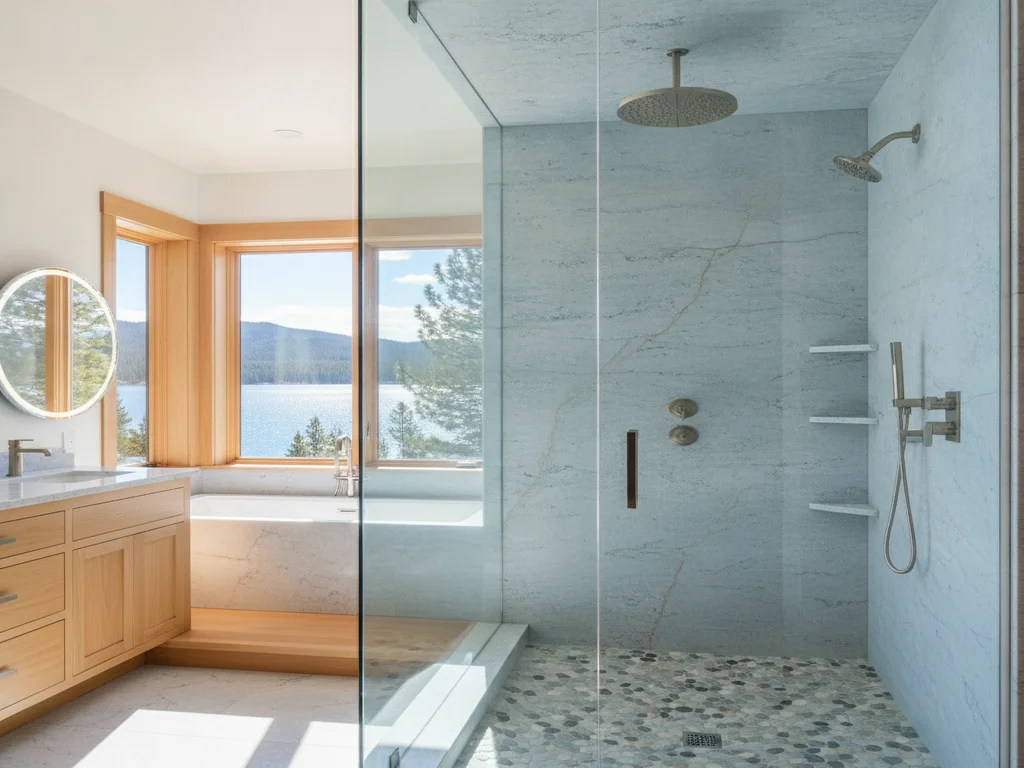
Custom Tile & Stonework
Published range $12,000 – $22,000 plus sales tax · custom tile shower range
Free in-home visit · Fixed written price · 1-year workmanship warranty
Tile and stone are where a bathroom earns its character, and where shortcuts stay hidden longest. Everything we set goes over a properly waterproofed substrate with the layout dry-laid first, so cuts land where they should and the pattern resolves at the corners. Local water matters to the finish decision too: Camas draws on city wells (with creek sources it can also use) and parts of outlying Clark County are on private wells, and dissolved minerals are harder on polished stone and clear glass than on a matte porcelain — so we match the material to the water it will live with.
What's included
Custom Tile & Stonework
- Floor, wall, and full shower-surround tile over waterproofed, crack-isolated substrate
- Natural stone and large-format porcelain, dry-laid before anything is set
- Mosaic accents, niches, and feature walls planned into the layout
- Sealing and finish selection matched to local groundwater mineral content
- Slip resistance specified by wet rating, not by appearance, on any floor tile
How it works
Our custom tile & stonework process
The right choice for homeowners who care how the tile actually meets the corners, and who want the layout, substrate, and material chosen deliberately rather than left to whoever shows up to set it.
- 1
Select & Layout
Material, size, and pattern are chosen together with the room, because a large-format tile that resolves beautifully on one wall can force awkward slivers on another. We plan where cuts land before anything is ordered.
- 2
Substrate & Waterproofing
The substrate is built flat and the waterproofing membrane goes in continuous, with crack-isolation where movement is expected. Tile is only as good as what it is bonded to, and this stage is invisible the moment it is covered.
- 3
Dry-Lay
We lay the pattern out without adhesive first to confirm cuts, alignment, and how natural variation distributes across the installation. Stone in particular varies slab to slab, and this is when it gets arranged rather than discovered mid-set.
- 4
Set & Grout
Tile is set to the planned layout, grouted, and sealed as the material requires. We clean the haze properly and review the finished work with you against the dry-lay.
What custom tile and stonework costs in Clark County
For a tiled shower, our published walk-in and custom tile shower range is $12,000 to $22,000, which includes the waterproofed pan and walls the tile sits on. Tile floors and feature walls outside the shower are usually priced as part of a larger bathroom project rather than on their own. The walk-in shower cost guide and bathroom remodel cost guide show how tile fits into each budget.
With tile, the material price per square foot is only part of the story. Size, shape and pattern change how long the layout and cutting take, and stone adds sealing and careful handling.
| Driver | Why it moves price |
|---|---|
| Material | This Old House (2026) puts porcelain or ceramic at $12–$30 per sq ft and natural stone at $20–$50 per sq ft, as cited in our walk-in shower cost guide |
| Tile size | Large-format tile needs a flatter substrate; small mosaics take longer to set and grout |
| Pattern | Herringbone, chevron and offset layouts produce more cuts than a straight stack |
| Niches, benches, curbs | Each adds inside corners that need their own membrane, slope and finished edges |
| Stone handling | Slabs and stone tile need sealing, and variation has to be sorted before setting |
Washington taxes labor as well as materials. Our published ranges are all on the pricing page.
Choosing tile and stone by the numbers
Three ratings on a tile spec sheet answer three different questions, and a bathroom needs all of them. Water absorption tells you how porous the body is: porcelain must absorb 0.5% or less, and certification through the Porcelain Tile Certification Agency confirms a tile labeled porcelain actually tests that way. PEI class measures how well a glaze resists wear; Class 3 or higher suits most bathroom floors. Wet DCOF measures grip when wet, and 0.42 is the ANSI A137.1 minimum for floors walked on wet. The tile standards guide explains each.
Natural stone is rated differently. There is no PEI class or porcelain-style certification; porosity varies by stone type and even by quarry. Granite tends to be dense, commonly cited around 0.4% absorption, while marble, limestone and travertine are calcium-based and etch when acids touch them. Most stone in a bathroom is sealed. For counters and vanity tops, the countertop materials guide compares quartz, granite, quartzite and marble.
Grout is the part of a tile job that needs the most care over time. For wet areas, a penetrating sealer is the better choice than a surface film, and This Old House advises resealing heavy-use areas every 6 to 12 months. The tile and grout care guide includes a quick water-drop test for when it is due.
- Shower walls versus panels: best shower wall materials.
- Floor tile beyond the shower, including heated floors and transitions: best bathroom flooring.
- Iron or manganese in well water stains grout and light stone first, so darker grout and low-porosity materials are a practical hedge. See water quality and your bathroom.
Code, substrate and moisture behind the tile
Tile and grout let some water through by design, so the waterproofing is a membrane behind them. A good membrane is rated to ANSI A118.10 and installed to a recognized ANSI A108 method, whether that is a bonded sheet or liquid system or a traditional mortar bed with a liner. One detail is easy to get backward: polymer-modified thin-set needs to dry to cure, so some sheet-membrane makers specify unmodified thin-set — follow the membrane maker’s instructions. The waterproofing standards guide covers this and the flood test, and the shower waterproofing guide compares the membrane systems.
Shower floors need slope built in before tile: Washington’s adopted plumbing code requires pitch toward the drain, and standard practice is 1/4 inch per foot. A tiled niche or bench is part of the same wet envelope, not a dry shelf, as the niche and bench guide explains.
Tile itself rarely needs a permit, but the work around it often does: reframing a wall for a niche or curbless pan, moving a drain, or adding heated-floor wiring. The Clark County permit guide lists the triggers. A properly sized, outdoor-ducted fan protects grout and stone from staying damp, per the CFM guide and marine-climate moisture guide.
Is custom tile and stone right for your home?
Custom tile is the right call when you want a specific look, layout or size that panels cannot give you, when a shower has an unusual shape, or when you want the shower floor, walls and bathroom floor to read as one design. Tile done to the standards above is also the longest-lived wall option, with ceramic and porcelain lasting 50 years or more per the shower wall materials guide.
It is a weaker fit if you want the lowest possible upkeep. Grout needs occasional sealing and stone needs more, so solid surface or acrylic panels may suit a guest bath or rental better. If you love the look of marble but not the maintenance, quartzite gives a similar look with far more durability.
For a full shower built around tile, see walk-in showers; for tile across a whole room, full bathroom remodeling. If resale is part of the decision, the resale value data shows midrange work recovers a larger share of its cost than upscale work, so pick tile and stone you want to live with.
Good to know
Custom Tile & Stonework questions
- Why is the dry-lay step worth the extra time?
- Because tile is unforgiving once it is set. Dry-laying reveals where cuts fall, whether the pattern resolves at corners and niches, and how color variation distributes — all of which are adjustable beforehand and expensive afterward. With natural stone it also lets us arrange the variation deliberately rather than accepting whatever order the crate came in.
- Is natural stone or large-format porcelain more durable in a wet area?
- Porcelain, in most bathroom applications. It is denser, effectively non-porous, and never needs resealing, whereas natural stone is porous and requires periodic maintenance. Where water carries dissolved minerals — as local groundwater can — that maintenance difference compounds. Stone still wins on character, so it is a question of where each belongs rather than which is better.
- What is crack-isolation and why does it matter under tile?
- It is a membrane layer that lets the substrate move slightly without transmitting that movement into the tile above. Buildings move seasonally, and in a climate with sustained moisture loading, framing moves as it takes on and releases humidity. Crack-isolation is what keeps a hairline substrate crack from telegraphing through as a cracked tile or a grout line that keeps reopening.
Custom Tile & Stonework by city
Custom Tile & Stoneworkin Vancouver, Camas & Clark County
Guides & ideas
Planning your custom tile & stonework project
Request a free estimate
Ready to start your custom tile & stonework bathroom project?
Tell us a little about your space and we'll follow up to schedule a free, no-obligation design consultation with clear, fixed pricing.
Prefer to talk? Call (360) 838-1340
Get Started Today
Ready to Transform Your Bathroom?
Let's create a space you'll love for years to come. Schedule a free consultation today.