Updated July 12, 2026 · 8 min read
People use "walk-in shower" and "tub-to-shower conversion" as if they mean the same project. They don't. One reuses an existing tub's footprint and plumbing to keep the cost and timeline down; the other can mean tearing into the room to build something larger and fully custom.
The right call depends on how many bathrooms the house already has, who's using this one, your budget, and how much upkeep you're willing to take on. This guide compares both paths on cost, safety, resale, and moisture control — including the honest counter-argument for keeping at least one tub in the home.
Key takeaways
- A tub-to-shower conversion is the lower-cost path since it reuses the existing footprint and plumbing; a walk-in shower can mean the same conversion or a larger, custom, possibly curbless build.
- An accessible or curbless walk-in averages about $9,500 (range $3,000–$15,000, per Fixr); Washington sales tax applies to labor and materials on top of that.
- A low-threshold shower with a well-sloped pan and adequate exhaust ventilation sheds water and resists mildew more effectively than an aging tub surround in a wet Pacific Northwest climate.
- Keep at least one bathtub in the home for resale and for families with young children — don't convert your only tub.
- Accessible remodels recoup roughly 64% at resale, and midrange bathroom remodels recoup about 80% nationally (Remodeling 2025 Cost vs. Value).
Two different projects, one label
A tub-to-shower conversion removes an existing tub or tub-shower combo and installs a shower in that exact footprint. Because the plumbing rough-in and the opening already exist, this is generally the faster and lower-cost path, and it's the most common way to retire a tub nobody in the house actually uses.
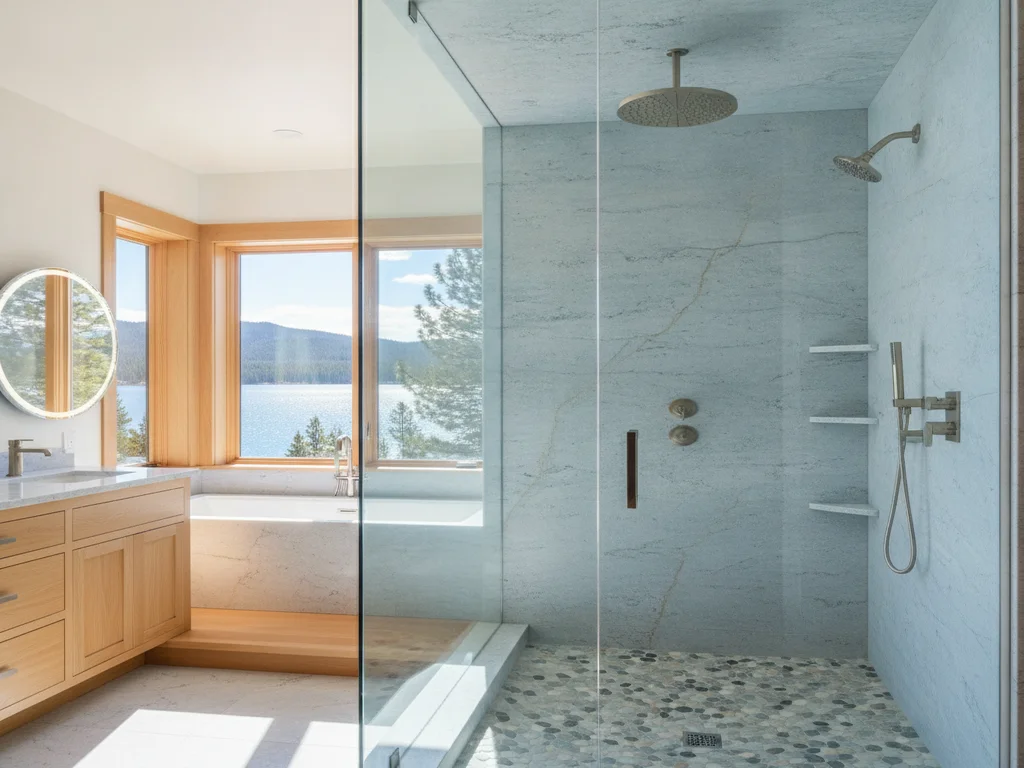
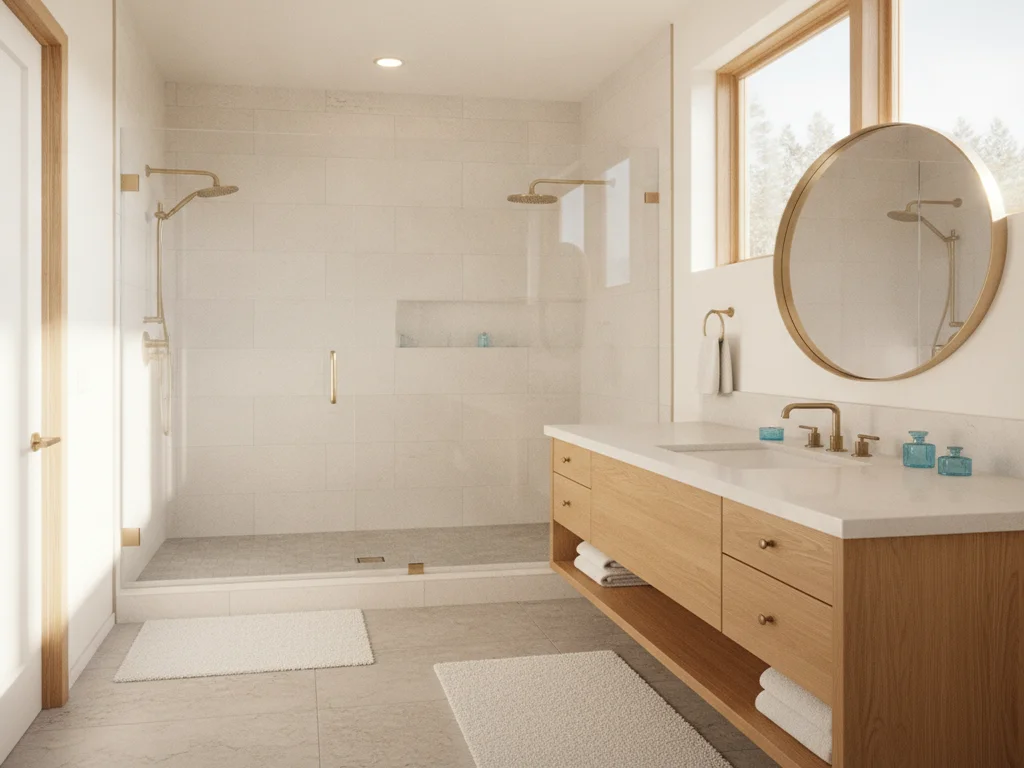
A walk-in shower is the broader term of the two. It can describe that same in-place conversion, or it can mean a larger, custom build — sometimes curbless with a zero-threshold entry — that expands past the old tub's dimensions entirely. The range runs from a prefab acrylic kit installed in a day to a fully tiled, glass-enclosed custom build.
What each path actually costs
Tub-to-shower conversion sits at the lower end because it reuses the existing footprint and rough plumbing — a prefab or acrylic swap is the affordable version, while converting that same space into a custom tiled shower runs higher. The two biggest swing factors are whether the plumbing has to move and which surround and floor materials you choose.
A standalone walk-in shower build climbs with size and finish level: a prefab acrylic kit is the entry point, and a fully custom tiled, glass-enclosed walk-in — especially one that expands beyond the tub's original footprint — is a considerably larger investment.
An accessible or curbless walk-in — zero-threshold entry, grab bars, a slip-resistant floor, comfort-height fixtures — runs about $9,500 on average with a $3,000–$15,000 range, per Fixr (2025/2026). For a fuller cost breakdown by scope, see our Camas bathroom remodel cost guide. Clark County, Washington sales tax applies to both labor and materials on any of these scopes and is worth budgeting for separately, since it isn't always broken out in a rough estimate.
| Factor | Tub-to-Shower Conversion | Walk-In Shower |
|---|---|---|
| Cost | Lower — reuses the existing footprint | Higher for a larger or custom build |
| Footprint | Stays inside the old tub space | Same footprint, or expanded/reconfigured |
| Timeline | Faster — plumbing and opening exist | Longer for a custom tiled build |
| Entry & accessibility | Easier than a tub; curbless optional | Best option for zero-threshold aging-in-place |
| Design flexibility | Limited to the existing layout | High — size, layout, tile, glass, bench |
Published dollar ranges for these projects vary too widely across sources to quote one reliable figure, so cost is compared here in relative terms; accessible-build and resale figures below are sourced individually. Washington sales tax applies to labor and materials on either scope.
The safety and moisture case for a shower
The daily argument for converting is largely about safety: stepping over a low or zero threshold is measurably easier than swinging a leg over a tub wall, and that difference is not trivial — the CDC reports that 81.1% of nonfatal bathroom injuries are falls, with roughly 37% occurring while bathing, showering, or getting in or out of a tub.
There's a moisture argument that carries extra weight in a Pacific Northwest climate, where humidity and standing water are a near-constant condition rather than a seasonal one. A curbless or low-threshold shower with a properly sloped pan sheds water more predictably than an aging tub surround with worn caulk, and a large-format or grout-light surround gives mildew fewer seams to establish in. Pairing either option with a correctly sized exhaust fan — the Home Ventilating Institute recommends roughly 1 CFM per square foot of bathroom floor area — clears humidity before it lingers long enough to become a mold problem, something the EPA notes can begin within 24 to 48 hours of sustained dampness.
- Safer, lower-effort entry — meaningful for aging in place and limited mobility
- A properly sloped, low-threshold pan sheds water more predictably than an old tub surround
- Fewer seams and grout lines give mildew less of a foothold, especially with adequate exhaust ventilation
- Accessible remodels recoup roughly 64% of cost at resale (Remodeling 2025 Cost vs. Value)
The honest case for keeping a tub
Converting every tub in a house can work against you when it's time to sell. Standard real-estate guidance is to keep at least one bathtub somewhere in the home — ideally a main or family bathroom — both for resale appeal and for households currently or eventually bathing young children. Buyers shopping with small kids frequently pass on homes with no tub at all.
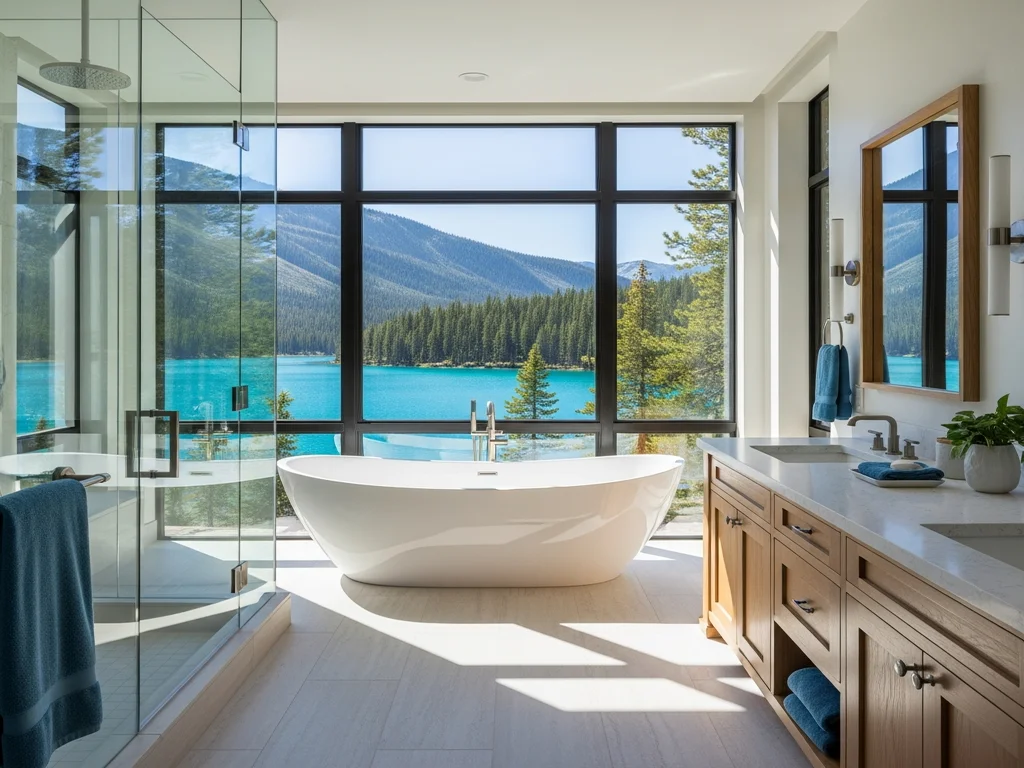
So if the bathroom you're considering holds the house's only tub, pause before converting it. A freestanding soaking tub added to a primary suite can satisfy a love of baths while a walk-in shower handles daily use elsewhere in the home.
- Keep at least one tub if this is the home's only one
- Households with young children often need a tub for bathing
- A freestanding tub in a primary suite can coexist with a walk-in shower elsewhere
- A completely tubless home can narrow the buyer pool at resale
Rule of thumb
Converting a rarely used secondary or primary-suite tub is usually a smart, value-friendly move — as long as the house keeps at least one tub somewhere for resale and for families.
Working through the decision
A short list of the factors that usually settle this, worked through in order:
- Household and life stage — aging in place or mobility needs favor a curbless walk-in; young children favor keeping a tub.
- Existing bathroom and tub count — with multiple bathrooms, converting one is low-risk; with only one bathroom, keep a tub somewhere.
- Budget — a straight conversion is the lower-cost path; a larger custom or curbless walk-in costs more.
- Layout — staying inside the existing footprint points to a conversion; expanding or reconfiguring points to a custom build.
- Resale strategy — keep at least one tub for buyers and families; lean on accessibility features for added value.
- Climate and upkeep — fewer grout seams and a properly waterproofed, curbless floor stay drier and more mildew-resistant than a tiled, curbed enclosure in a wet climate.
How this plays out at resale
Bathroom work holds its value well overall. A midrange bathroom remodel recoups about 80% of its cost nationally — the highest level since 2007 — per Remodeling's 2025 Cost vs. Value report, while accessible / Universal Design bathroom projects recoup roughly 64%.
Put simply: a thoughtful conversion or walk-in shower is generally a sound investment as long as the home isn't left without a single tub. Weigh the upgrade you'll use every day against what a future buyer is likely to expect.
Frequently asked questions
- Does removing a bathtub hurt resale value?
- It can, if it's the home's only tub. Standard real-estate guidance is to keep at least one bathtub — usually in a main or family bath — because many buyers, especially families with young children, expect one. Converting a tub to a shower is generally fine as long as the house still has a tub somewhere else.
- How much does a tub-to-shower conversion cost?
- It's usually one of the more affordable bathroom projects because it reuses the existing footprint and plumbing. A prefab or acrylic swap is the lower-cost path, while a custom tiled walk-in in the same space costs more. Because the range depends on whether plumbing moves and which materials you pick, the most reliable number is a fixed quote for your specific bathroom — factor in Washington sales tax on both labor and materials.
- Is a walk-in shower good for aging in place?
- Yes. A curbless or zero-threshold walk-in with grab bars, a slip-resistant floor, and comfort-height fixtures is far safer than stepping over a tub wall — the CDC reports most nonfatal bathroom injuries are falls, many while getting in or out of a tub. An accessible build averages about $9,500 (range $3,000–$15,000) per Fixr.
- How does a walk-in shower handle moisture better than a tub in a wet climate?
- A properly sloped, low-threshold pan sheds water more predictably than an aging tub surround, and fewer grout seams give mildew less of a foothold. Pairing that with an exhaust fan sized to roughly 1 CFM per square foot (HVI guidance) clears humidity before it lingers long enough to become a mold problem — the EPA notes mold can begin forming within 24 to 48 hours of sustained dampness.
- Should I keep a bathtub?
- Keep at least one if it's the home's only tub, if you have or expect young children, or if you genuinely enjoy soaking. If you have multiple bathrooms and rarely use the tub you're replacing, converting it to a shower is usually a smart, value-friendly upgrade.
- Will a bathroom remodel pay off when I sell?
- Generally, yes. Remodeling's 2025 Cost vs. Value report shows a midrange bathroom remodel recoups about 80% of its cost nationally — the highest since 2007 — while accessible / Universal Design bathroom projects recoup roughly 64%.
Sources
- Fixr — Bathroom Remodel ROI & Cost vs. Value
- CDC MMWR — Nonfatal Bathroom Injuries
- CustomCraft DBR — 2025 Cost vs. Value Report
- Washington Department of Revenue — Construction Industry Guide
- Home Ventilating Institute — Certified Ratings & Sizing Guidance
- EPA — A Brief Guide to Mold, Moisture and Your Home
Claims and figures are drawn from the sources above and provided for general guidance; your project may vary. Photography is illustrative of design concepts. For a fixed price on your specific bathroom, request a free estimate.