Updated July 12, 2026 · 8 min read
An accessible bathroom remodel is a bundle of individual features, not one fixture: reinforced blocking behind the wall for grab bars, a curbless shower entry, comfort-height fixtures, and clearances wide enough for a walker or wheelchair to turn around. Some of those features are inexpensive add-ons to a remodel that's already happening; others — a curbless entry, a widened doorway — reshape the floor plan and change the budget meaningfully.
Camas Bath doesn't publish a standalone accessible-bathroom rate, since the right scope depends entirely on which features a household actually needs. This guide gathers cited 2025–2026 national figures from Fixr for the individual features, the federal dimensional standards from the U.S. Access Board that those features have to meet, and a regional funding resource available to Washington homeowners.
Key takeaways
- Camas Bath doesn't publish a standalone accessible bathroom rate — features are typically built into a Guest ($15,000–$28,000) or Master ($28,000–$60,000+) remodel scope, or priced individually for a narrower project.
- Fixr (2025) prices the individual features: grab bars $85–$300, curbless shower conversion $750–$3,000, walk-in tub $5,000–$8,500, widened doorway $300–$2,500, accessible sink $450–$800.
- The U.S. Access Board's ADA Standards set the dimensions behind these features: 17"–19" comfort-height toilet and seat height, 30"×60" minimum roll-in shower clearance, ½" maximum threshold height.
- The Northwest Access Fund offers Washington homeowners (and other Pacific Northwest states) accessibility-modification loans up to $60,000 over 10 years — a regional resource beyond the national VA HISA grant.
- Any contractor performing this work in Washington must be registered with the state Department of Labor & Industries and, for structural changes, typically needs a local building permit.
The short answer
Fixr (2025) breaks accessible/disability remodeling down by feature: grab bars run $85–$300 installed, a curbless shower conversion runs $750–$3,000, a walk-in tub runs $5,000–$8,500, widened doorways run $300–$2,500, and an accessible wall-mounted sink runs $450–$800. A full bathroom renovation built around accessibility, per Fixr, starts around $4,500–$9,000 at the low end — well below a full remodel if only a handful of features are needed, and closer to full-remodel territory once several are combined.
None of that pricing changes by region — grab bars and comfort-height toilets cost about the same to install in Clark County as anywhere else. What does change in Washington is the paperwork: any contractor performing this work has to be registered with the state Department of Labor & Industries, and structural changes like widened doorways or a recessed shower floor typically require a permit from the city or county where the home sits.
Grab bars and wall blocking
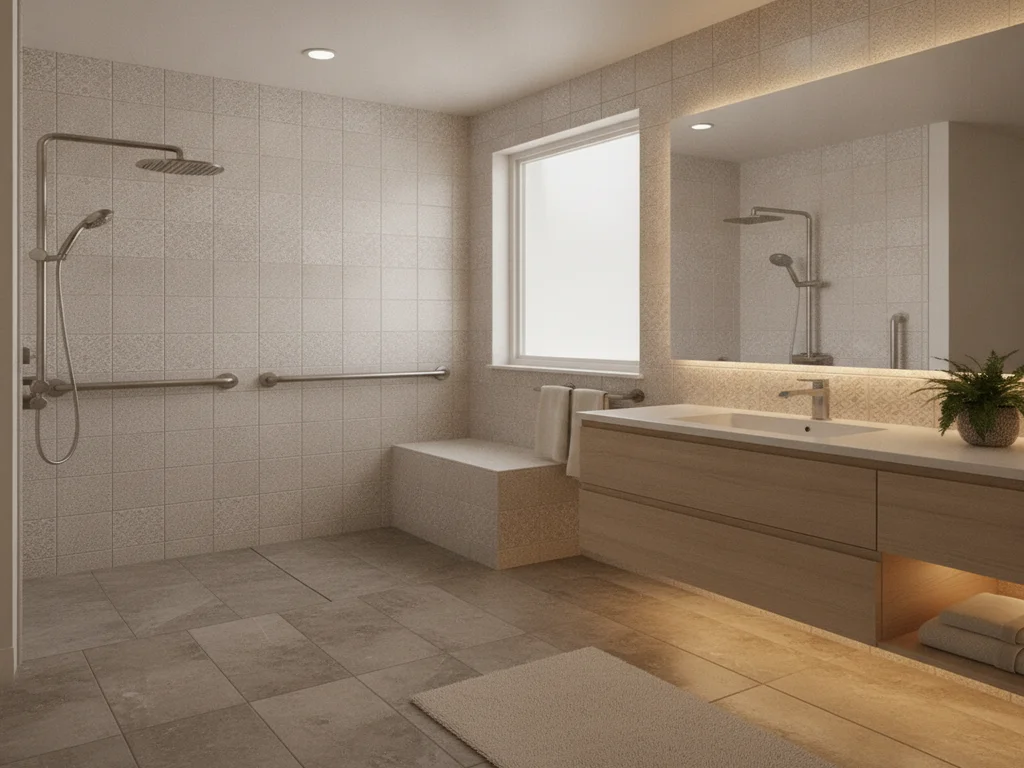
Fixr (2025) prices grab bar installation at $85–$300, describing "stainless steel L-shaped grab bars" as the most common choice. That price covers hardware going into a wall that's already reinforced. The real cost question is whether blocking exists behind the drywall in the right spot — solid wood or engineered backing installed during framing so the bar can be lag-bolted into structure instead of relying on drywall anchors alone.
The U.S. Access Board's ADA Standards require grab bars to withstand "a vertical or horizontal force of 250 lbs. at any point on the grab bar, fastener, mounting device, or supporting structure," with 1½ inches of clearance from the wall. Meeting that load rating is a framing question, which is why adding blocking during any remodel — even for a household that doesn't need a bar installed today — is worth doing before the wall gets closed up.
Curbless entry and clearances
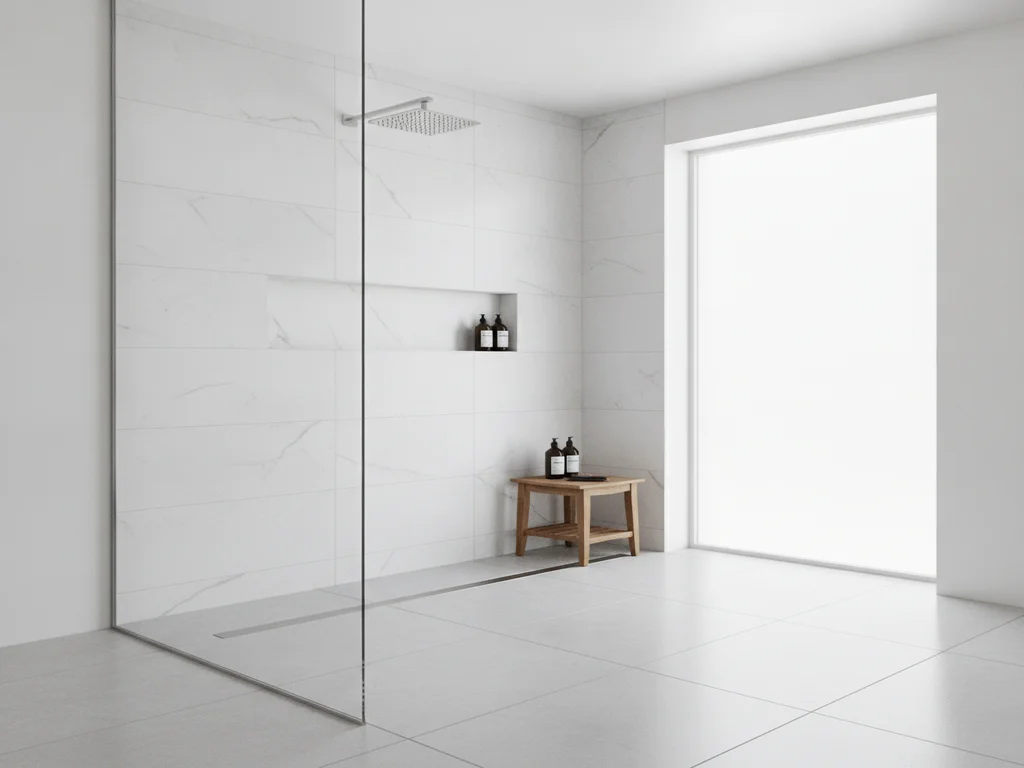
A curbless, zero-threshold shower entry is one of the more consequential accessibility features, since it touches the subfloor and drain rather than just fixtures — our curbless shower cost guide covers that build in detail, including why it takes on added weight in a marine climate. Fixr (2025) prices the shower conversion itself at $750–$3,000, separate from the floor and waterproofing work a curbless entry requires.
The U.S. Access Board's ADA Standards define the clear floor space a roll-in shower needs: "30 inches deep minimum and 60 inches wide minimum," while a transfer-style shower needs "36 inches minimum wide and 48 inches minimum long." Thresholds are capped at "½ inch high maximum and, if greater than ¼ inch high, beveled 1:2 max," with the standard specifically recommending "trench drains and other designs that allow a flush transition to the shower floor."
- Roll-in shower clear floor space: 30" deep × 60" wide minimum (U.S. Access Board, ADA Standards)
- Transfer shower clear floor space: 36" wide × 48" long minimum (U.S. Access Board, ADA Standards)
- Threshold height: ½" maximum, beveled 1:2 if over ¼" (U.S. Access Board, ADA Standards)
- Doorway width: minimum 32" to accommodate a wheelchair, per Fixr (2025), which prices widening at $300–$2,500
Comfort-height fixtures
The U.S. Access Board's ADA Standards specify a toilet seat height of "17 inches [to] 19 inches high measured to the top of the seat" — the dimension the plumbing industry sells as a "comfort-height" or "chair-height" toilet, several inches taller than a standard residential toilet. The same standard sets shower and tub seat height at that same 17–19 inch range, so a seated transfer approximates a wheelchair seat height.
Fixr (2025) prices a raised or accessible toilet with integrated grip bars at $100–$1,600, and an accessible wall-mounted sink — set at a height and with knee clearance underneath that a wheelchair user can roll up to — at $450–$800. Neither fixture requires a full remodel to install if the existing rough-in plumbing doesn't need to move.
| Feature | Cost | Source |
|---|---|---|
| Grab bars, installed | $85–$300 | Fixr (2025) |
| Curbless shower conversion | $750–$3,000 | Fixr (2025) |
| Walk-in tub | $5,000–$8,500 | Fixr (2025) |
| Widened doorway (32" ADA minimum) | $300–$2,500 | Fixr (2025) |
| Accessible wall-mounted sink | $450–$800 | Fixr (2025) |
| Raised/accessible toilet | $100–$1,600 | Fixr (2025) |
| Full accessible bathroom renovation | $4,500–$9,000+ | Fixr (2025) |
Source: Fixr, "Cost to Remodel to Adapt for a Disability" (2025). Figures are national and per-feature — Washington sales tax on labor and materials, roughly 8.6%–8.8% in Clark County, applies on top.
Regional funding and the state contractor requirement
The Northwest Access Fund, a regional nonprofit lender serving Washington homeowners (among other Pacific Northwest states), offers home-modification loans up to $60,000 over a 10-year term specifically for accessibility projects like these — a resource worth knowing about before assuming a project has to be paid out of pocket. Veterans may separately be able to apply VA Home Improvements and Structural Alterations (HISA) grant funding toward roll-in showers and other bathroom accessibility modifications, per the VA's Prosthetic and Sensory Aids Service; that program requires a VA physician's prescription and is a funding source, not a cost estimate.
Whichever features you choose, Washington law requires the contractor doing the work to be registered with the state Department of Labor & Industries (L&I) — the agency that replaces the general-contractor licensing board you'd find in other states — and bonded and insured. Structural changes like a widened doorway or a recessed shower floor also typically need a permit from the city or county building department before work starts.
Accessible now vs. aging-in-place planning
These are related but not identical projects. An accessible bathroom remodel solves a current mobility need — a household member who uses a wheelchair, walker, or has a condition that makes a standard bathroom difficult to use safely today. An aging-in-place bathroom remodel plans ahead: blocking behind the tile even when no bar is installed yet, a curbless entry sized generously, comfort-height fixtures chosen before they're strictly needed — all done during a remodel that would happen anyway, since retrofitting later means opening the wall again.
The feature costs above apply to both approaches; the difference is timing and whether every feature gets installed now or just prepared for later.
What Camas Bath publishes
Camas Bath doesn't publish a standalone accessible bathroom rate — accessible features are typically built into a full remodel scope, most often a Guest Bathroom Remodel (published at $15,000–$28,000) or a Master Bathroom Remodel (published at $28,000–$60,000+), depending on room size and how many features are combined. A narrower scope — grab bars and a comfort-height toilet, without touching the shower floor — can run well below either published range, closer to the per-feature Fixr figures above. For the full remodel picture, see our Camas bathroom remodel cost guide.
3-year workmanship warranty
Every accessible bathroom feature we install — grab-bar blocking, curbless entries, comfort-height fixtures, and widened clearances alike — is backed by a 3-year workmanship warranty on our construction.
Frequently asked questions
- How much does an accessible bathroom remodel cost in Camas?
- Camas Bath doesn't publish a standalone accessible bathroom rate — it depends on which features are needed. Nationally, Fixr (2025) prices individual features from $85 (grab bars) up to $8,500 (a walk-in tub), with a full accessible bathroom renovation starting around $4,500–$9,000. Combining several features, or rebuilding the shower floor for a curbless entry, typically moves the project into our published Guest ($15,000–$28,000) or Master ($28,000–$60,000+) remodel ranges.
- Is there funding help for an accessible bathroom remodel in Washington?
- Yes. The Northwest Access Fund, a regional nonprofit serving Washington and neighboring Pacific Northwest states, offers accessibility-modification loans up to $60,000 over a 10-year term. Veterans may also qualify for VA Home Improvements and Structural Alterations (HISA) grant funding with a physician's prescription, per the VA's Prosthetic and Sensory Aids Service.
- What's the difference between an accessible bathroom and an aging-in-place bathroom?
- An accessible bathroom remodel solves a current mobility need — a household member who needs a curbless entry, grab bars, or comfort-height fixtures today. An aging-in-place remodel plans the same features in ahead of time, such as blocking behind the tile or a generously sized curbless entry, during a remodel that would happen anyway.
Sources
- Fixr — Cost to Remodel to Adapt for a Disability (2025)
- U.S. Access Board — ADA Standards, Chapter 6: Bathing Rooms
- U.S. Access Board — ADA Standards, Chapter 6: Toilet Rooms
- Northwest Access Fund — Home Modification Resources
- Washington State Department of Labor & Industries — Register as a Contractor
- U.S. Department of Veterans Affairs — Home Improvements and Structural Alterations (HISA)
Claims and figures are drawn from the sources above and provided for general guidance; your project may vary. Photography is illustrative of design concepts. For a fixed price on your specific bathroom, request a free estimate.