Updated July 12, 2026 · 7 min read
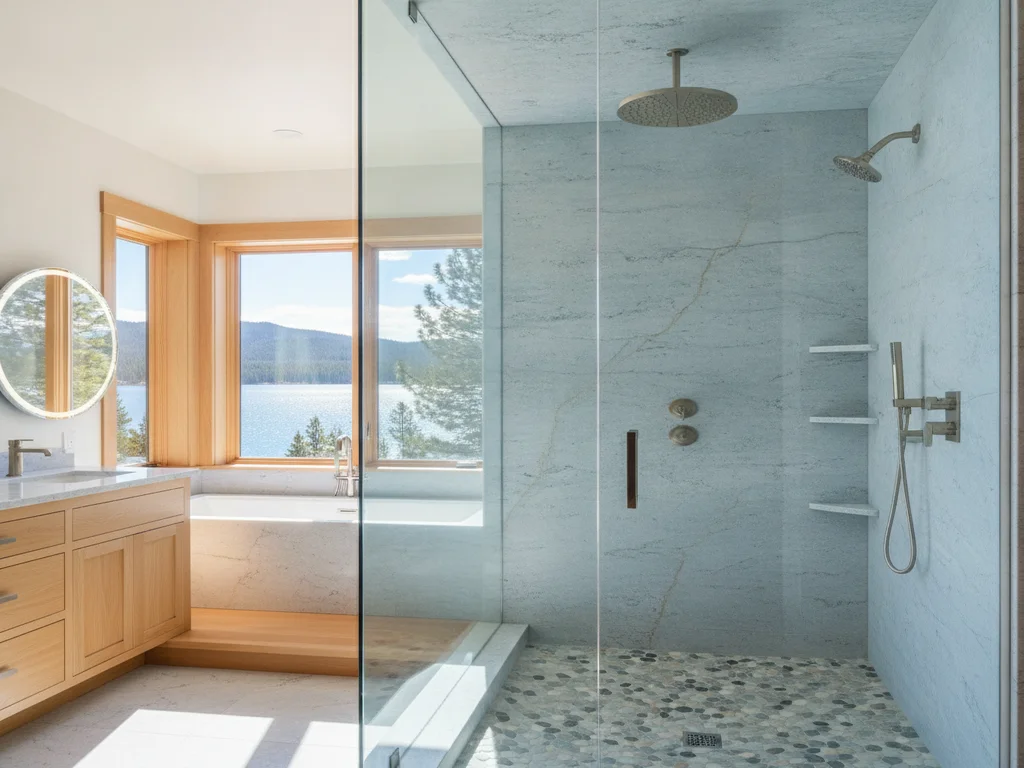
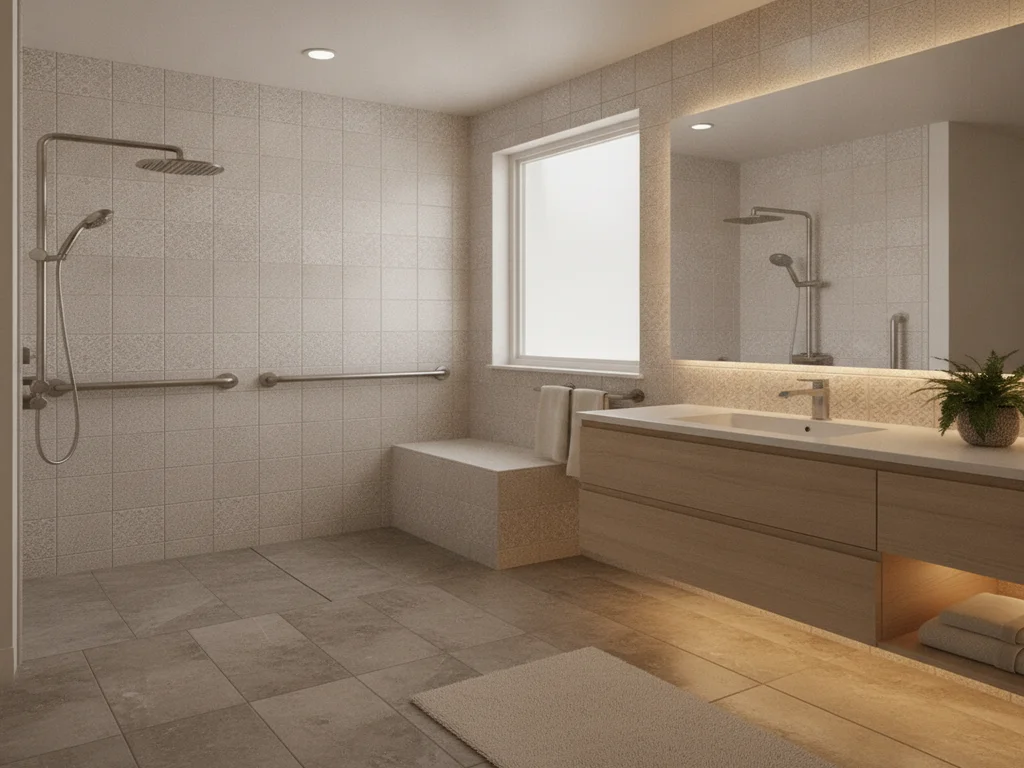
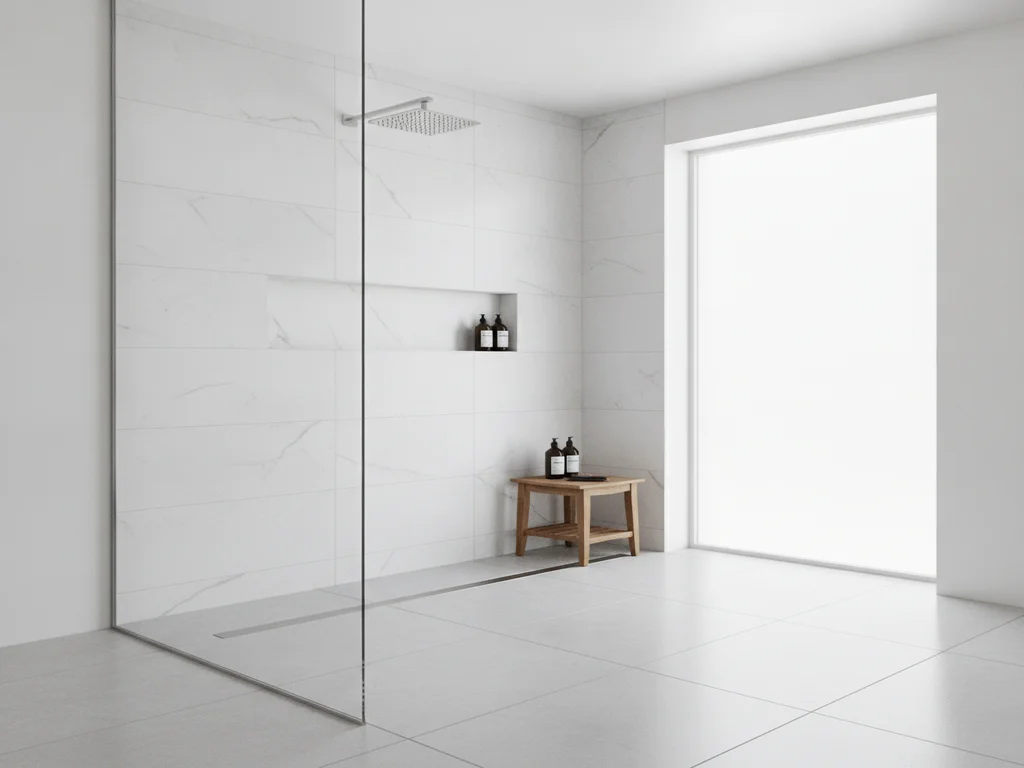
A curbless shower sits flush with the bathroom floor instead of behind a raised threshold. That flush transition looks simple from the outside, but it changes how the floor underneath is built: the subfloor typically has to be recessed or reframed to create the slope that carries water to the drain, since there's no curb left to hold it back.
Camas Bath doesn't publish a standalone rate for a curbless shower — it's a build choice layered onto a walk-in shower, and the honest way to price it is against national data for what a curbless entry typically adds. This guide gathers cited 2023–2026 figures from This Old House, Bob Vila, and Fixr, plus manufacturer and building-science guidance on why the waterproofing and drainage details matter more here than in a drier climate.
Key takeaways
- Camas Bath doesn't publish a standalone curbless shower rate — it's a configuration of a Walk-In / Custom Tile Shower, published at $12,000–$22,000.
- National sources frame curbless cost differently: Fixr (2025) says it "doesn't usually add much" (avg. $6,000), while This Old House (2026) says the required subfloor work pushes it into a higher pricing tier.
- The floor has to be recessed or reframed to build in slope without a curb — on framed floors that means cutting into joists; on slab floors it means cutting into concrete.
- Curbless showers are almost always built with a linear drain, which allows a single-plane slope and supports large-format tile (Schluter).
- Waterproofing has to extend across the full wet zone on a curbless build, which matters more in a marine climate's high year-round humidity (Building Science Corporation).
The short answer
Fixr (2025) prices walk-in shower installation nationally at $5,000–$11,000, averaging $8,000, with premium builds running up to $20,000 — and notes that going curbless or barrier-free "doesn't usually add much to the cost," pricing that configuration at an average of $6,000 within its overall walk-in range.
This Old House (2026) frames it differently: its walk-in shower range runs $4,000–$20,000 (average $12,000), and it states plainly that a curbless design "requires subfloor modification to create a proper drainage slope," and that the added structural work and expanded waterproofing "typically increases labor costs and pushes the project into a higher pricing tier." The two sources aren't contradicting each other so much as describing different scopes of curbless build — a straightforward pan swap versus a full subfloor rework — which is exactly why the range is wide.
Why the floor construction changes
A standard shower pan sits on top of the subfloor behind a curb, which contains water within the pan itself. Remove the curb and the floor has to do that job instead: the pan area gets recessed into (or built up around, on the room side) the subfloor so the finished shower floor and the surrounding bathroom floor end up level, with slope built into the recessed section to carry water to the drain.
On a home with a framed floor over a crawlspace — common throughout Camas's hillside subdivisions and much of older Vancouver — that recess is typically cut into the floor joists, which is a job for a licensed contractor rather than a tile setter, since it touches structural framing. On a slab-on-grade floor, the equivalent work means cutting into the concrete slab itself. Either way, this framing or slab work is the main reason This Old House frames curbless as pushing a project into a higher pricing tier: it's added structural labor a standard curbed shower never requires.
Cost by shower type
Bob Vila's 2023 shower installation guide prices an accessible, curbless-entry shower meeting ADA no-threshold requirements separately from a standard walk-in build.
| Shower type | Cost | Source |
|---|---|---|
| Accessible / curbless entry (ADA no-threshold) | $3,000–$6,000 | Bob Vila (2023) |
| Curbless / barrier-free (average) | $6,000 | Fixr (2025) |
| Walk-in shower, typical range | $5,000–$11,000 (avg. $8,000) | Fixr (2025) |
| Walk-in shower, typical range | $4,000–$20,000 (avg. $12,000) | This Old House (2026) |
Sources: Bob Vila shower installation cost guide (2023); Fixr walk-in shower installation cost (2025); This Old House walk-in shower cost guide (2026). Figures are national — Washington sales tax on labor and materials, roughly 8.6%–8.8% in Clark County, applies on top.
Linear drains, and why waterproofing matters more here
Curbless showers are almost always built with a linear drain rather than a central point drain. Schluter, a waterproofing and drain manufacturer, explains that a linear drain lets the shower floor slope in a single plane toward one edge, rather than sloping down from all four directions toward a center drain — which makes it possible to use large-format tile that would otherwise need to be cut to fit a multi-directional slope.
Because the curbless floor sits flush with the rest of the room, waterproofing has to extend further than it would behind a curb — and that extended waterproofing carries more weight in Clark County than it would in a dry climate. Building Science Corporation, an independent building-science research firm, notes that marine climates like the Pacific Northwest run high year-round humidity even in cooler months, which changes how moisture moves through wall and floor assemblies and is part of why the region's building code leans on more forgiving, moisture-adaptive vapor strategies rather than a single fixed vapor barrier. In a bathroom, that translates to one practical rule: a curbless, open shower floor needs continuous waterproof membrane across the whole wet zone, not just the pan, so vapor driven by a daily hot shower has nowhere to work its way into the subfloor.
- Linear drain: enables single-plane floor slope and supports large-format tile (Schluter, manufacturer)
- Waterproofing system: $800–$1,500 installed; curbless/open layouts need full-floor coverage, not just the pan (This Old House, 2026)
- Drain line installation: $1,000–$7,000, depending on routing (Bob Vila, 2023)
- Plumbing fixture modification: $600–$1,600 per fixture (Bob Vila, 2023)
- Marine climates carry high year-round humidity, which is why moisture-adaptive vapor strategies matter more here than in a dry climate (Building Science Corporation)
Permits in Clark County
Because a curbless build usually means cutting into the subfloor or slab, it typically crosses from cosmetic work into permitted structural and plumbing work. In Camas, that permit runs through the city's Building Division; in Vancouver, through the city's Permit Center; unincorporated parts of the county route through Clark County Community Planning. Whoever pulls the permit also has to be a contractor registered with Washington's Department of Labor & Industries — the state's equivalent of a contractor licensing board.
What Camas Bath publishes
Camas Bath doesn't publish a standalone rate for a curbless shower — it's built as a configuration of a Walk-In / Custom Tile Shower, which is published at $12,000–$22,000. Based on the national data above, the curbless entry itself is usually not the largest line item; the floor recess or joist work, the linear drain, and the extended waterproofing are what typically move a given project toward the upper end of that range rather than the lower end. For the underlying shower build cost, see our walk-in shower cost guide and our Camas bathroom remodel cost guide.
3-year workmanship warranty
Every curbless shower we install is backed by a 3-year workmanship warranty on our construction, in addition to manufacturer warranties on the drain and waterproofing components we use.
Frequently asked questions
- How much does a curbless shower cost in Camas?
- Camas Bath doesn't publish a standalone curbless shower rate — it's built as a configuration of a Walk-In / Custom Tile Shower, published at $12,000–$22,000. Nationally, Bob Vila (2023) prices an accessible curbless-entry shower at $3,000–$6,000, Fixr (2025) prices curbless/barrier-free showers at an average of $6,000, and This Old House (2026) puts the broader walk-in shower range at $4,000–$20,000.
- Why does a curbless shower cost more than a standard shower?
- Removing the curb means the floor itself has to create the drainage slope the curb used to help contain. This Old House (2026) explains that curbless designs require subfloor modification for a proper slope, plus expanded waterproofing across the floor — added structural and waterproofing labor a standard curbed shower doesn't need.
- Does a curbless shower need extra waterproofing in a wet climate like Clark County?
- Yes, in practice. Because the curbless floor sits flush with the rest of the room, waterproofing has to cover the full wet zone rather than just the shower pan. Building Science Corporation notes that marine climates like the Pacific Northwest carry high year-round humidity, which is part of why continuous, full-floor waterproofing matters more here than in a drier climate.
Sources
- This Old House — How Much Does a Walk-In Shower Cost? (2026)
- Bob Vila — Shower Installation Cost: How to Budget for a Bathroom Upgrade (2023)
- Fixr — Walk-In Shower Installation Cost (2025)
- Schluter — Shower with Linear Drain (manufacturer)
- Building Science Corporation — BSD-106: Understanding Vapor Barriers
- City of Camas — Building Division
- Washington Department of Revenue — Local Sales & Use Tax Rate Table
Claims and figures are drawn from the sources above and provided for general guidance; your project may vary. Photography is illustrative of design concepts. For a fixed price on your specific bathroom, request a free estimate.