Updated July 12, 2026 · 10 min read
The short answer
A spa-grade primary bathroom pairs a freestanding soaking tub, a properly membraned steam shower, radiant-heated floors, and sealed natural stone into one retreat. For Camas homes on Lacamas Lake, Round Lake, or the Prune Hill and Grass Valley hillsides, the view and the square footage are usually already there — what determines whether it performs is getting the generator sizing, waterproofing, and flow rates right.
Key takeaways
- 77% of design professionals surveyed by NKBA expect hospitality-inspired wellness features — including steam, soaking tubs, and heated floors — to be a leading 2026 bath trend, with primary baths increasingly designed as personal spa spaces.
- Steam shower generators are sized to the enclosure's cubic volume (length × width × height), per Mr. Steam — an oversized or undersized generator is the single most common reason a steam shower underperforms.
- TCNA methods SR613/SR614 require a membrane meeting ANSI A118.10 rated for steam-room use, because cementitious grout transmits water vapor even when the tile itself is impermeable — a steam shower is a different waterproofing assembly than a standard shower.
- Per the U.S. Department of Energy, radiant floor heating is generally more efficient than baseboard heating and usually more efficient than forced-air heating, since it eliminates duct losses entirely.
- EPA WaterSense-labeled showerheads are certified to 2.0 gallons per minute or less, roughly 20% below the 2.5 gpm standard fixture — worth knowing before speccing a multi-head rainfall-and-body-spray system, since each head adds to total flow.
- Natural stone in a wet bathroom generally needs a periodic penetrating sealer, per the Natural Stone Institute, and calcareous stones (most marble, travertine, limestone) require non-acidic cleaners — a material decision that has to be made before installation, not after.
Why Camas view homes are already halfway to a spa retreat
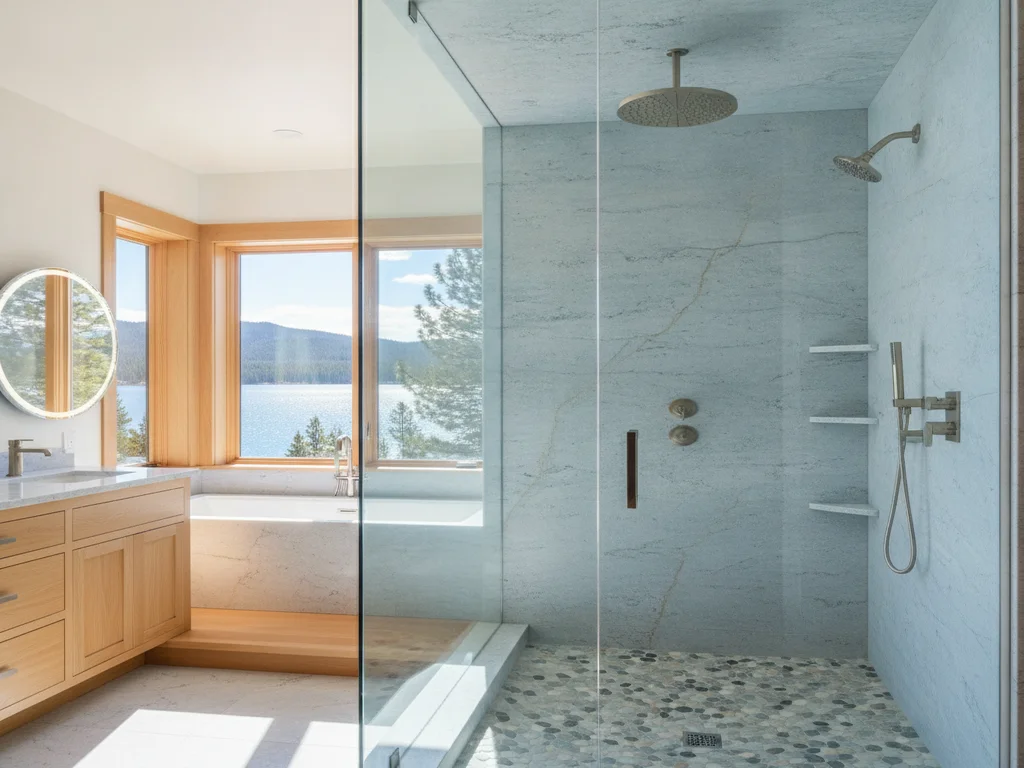
A genuine spa bathroom needs two things most houses don't have: enough square footage to fit a soaking tub and a separate steam shower without cramming them together, and a reason to linger — a view, quiet, natural light. Camas homes wrapped around Lacamas Lake and Round Lake, and the hillside subdivisions climbing Prune Hill and Grass Valley toward the Columbia River Gorge, tend to have both already. A primary suite on the lake side of a Prune Hill build, or a hillside lot with a Gorge sightline, is the kind of room a freestanding tub and a full-height window were made for.
Downtown Camas' mill-era homes are a different starting point — smaller, older layouts with a clawfoot tub in a room built before central heat was a given — but the same core ideas apply at a smaller scale: radiant floor heat instead of a rug on cold tile, a compact steam unit instead of a walk-in one, natural stone chosen for the room's actual humidity load. The features below scale to the house; what doesn't change is getting the mechanicals — steam generator sizing, waterproofing, flow rate — right underneath the design.
The freestanding soaking tub as the anchor
In NKBA's most recent bath-trends research, 77% of surveyed design professionals expect hospitality-inspired wellness features — deep soaking tubs with ergonomic support chief among them — to define 2026 bath design, as primary bathrooms shift from purely functional rooms toward personal spa spaces. A freestanding tub earns that role because it's the one fixture in the room that's purely about slowing down, not utility.
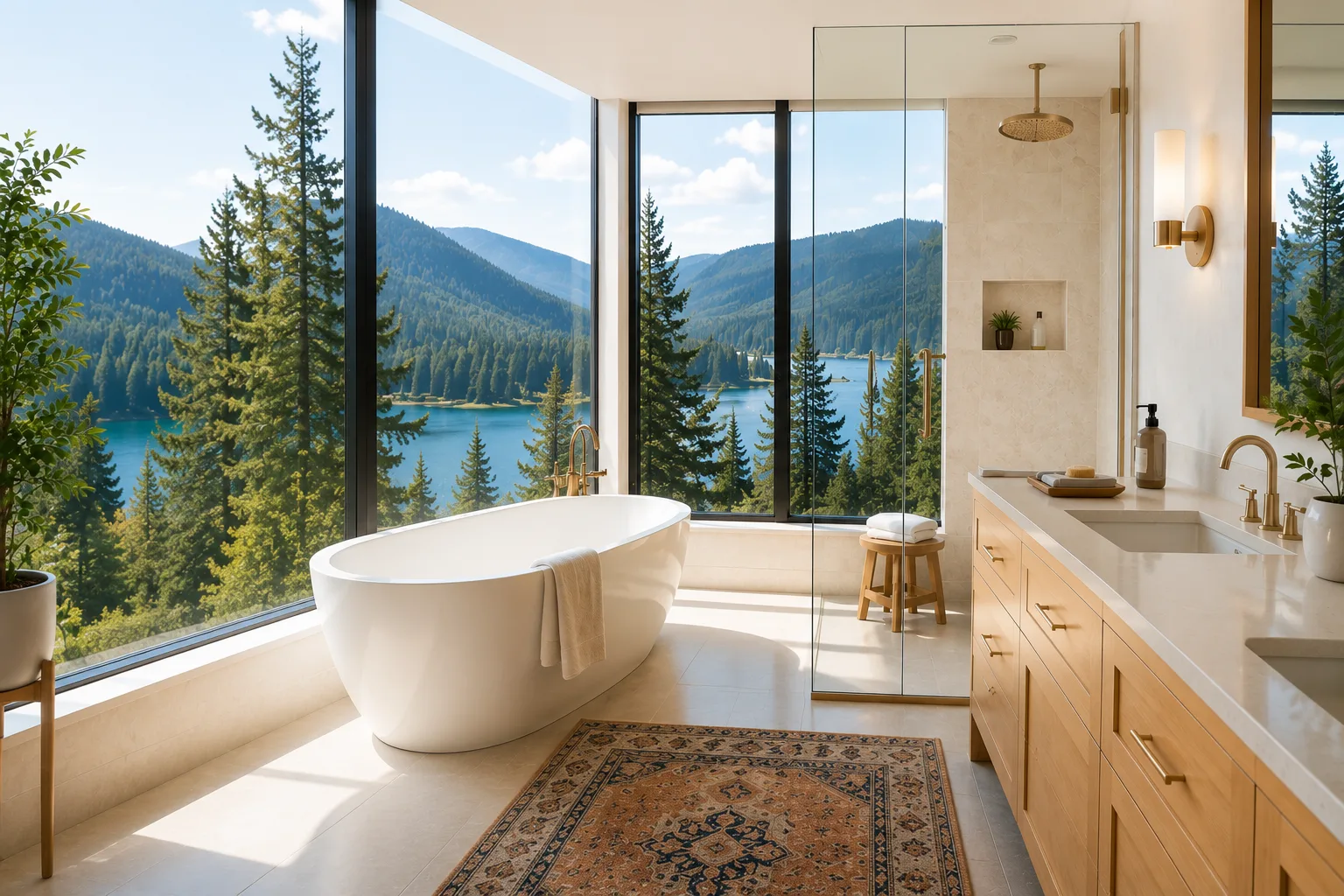
Placement matters more than tub choice here: a freestanding tub set to catch a Lacamas Lake or Gorge sightline through an unobstructed window does more for the room than an upgraded tub model in a corner. On a Grass Valley or Prune Hill lot with real elevation, that's often the single highest-leverage design decision in the whole remodel.
Steam shower: sizing and waterproofing, not just glass and tile
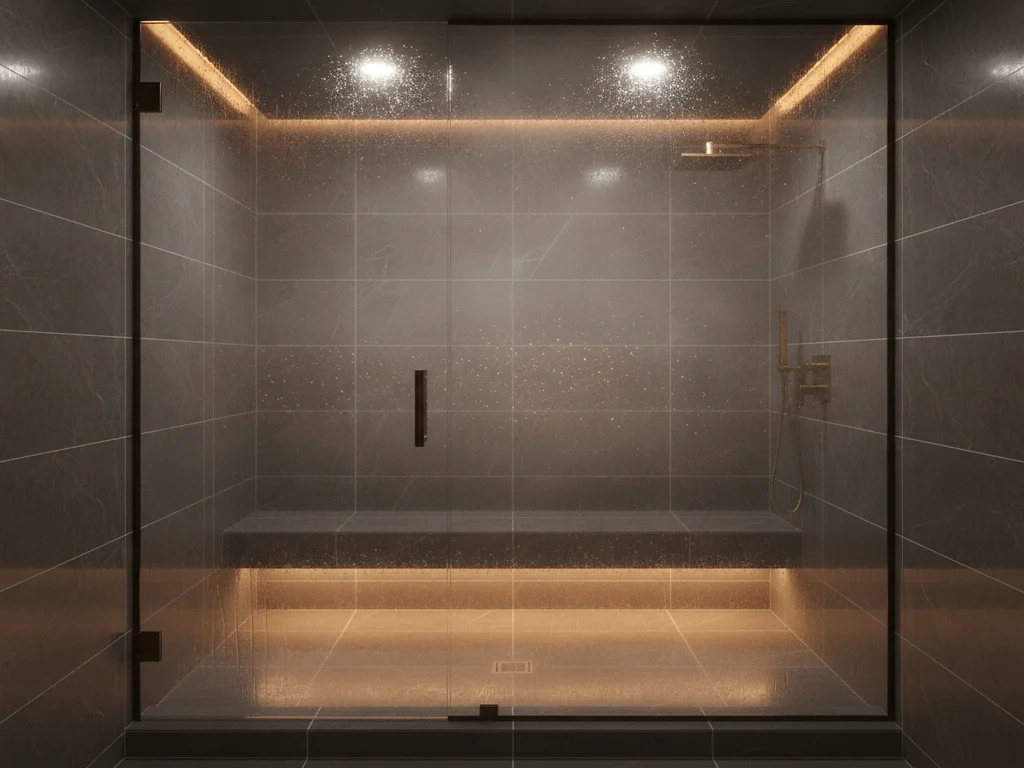
A steam shower looks like a slightly upgraded tile shower with a door that seals. Mechanically, it's a different system. Mr. Steam sizes its generators to the enclosure's actual cubic volume — length times width times height — along with material and ceiling-height factors, because an undersized generator never reaches temperature and an oversized one wastes energy and can run hotter than intended. That sizing has to happen before tile goes up, not after.
Waterproofing is the part that's easy to underestimate. TCNA methods SR613 and SR614 call for a membrane meeting ANSI A118.10, specifically rated by its manufacturer for steam-room use — a standard shower membrane isn't automatically rated for sustained steam exposure. TCNA notes the reason: even fully glazed, vapor-impermeable tile sits over cementitious grout that readily transmits water vapor, so the membrane behind the tile is doing the real waterproofing work, and gypsum wallboard has no place in the assembly. Get a full breakdown of what that costs to do correctly in our steam shower cost guide for Camas, and see the finished-room options in steam shower installation in Camas.
Sauna-adjacent, without the separate room
Not every primary suite has room for a standalone sauna. A well-built steam shower — sized correctly and run at a lower, longer setting — delivers a comparable wind-down ritual inside the existing shower footprint, which is usually the more realistic upgrade for an existing Camas primary bath.
Heated floors: the efficiency case, not just the comfort case
Heated floors get sold on comfort, but there's a real efficiency argument underneath it. Per the U.S. Department of Energy, radiant heating is generally more efficient than baseboard heating and is usually more efficient than forced-air heating specifically because it eliminates duct losses — the heat goes into the room and the people in it, not into ductwork running through unconditioned space. In a marine climate where a bathroom floor is cold and damp for a large share of the year, that efficiency case matters as much as the comfort one.
Electric radiant mats are the common retrofit choice for a single primary bathroom — no boiler loop required — while hydronic systems make more sense tied into a whole-house system. Either way, the floor heat needs to be planned alongside the waterproofing membrane and the tile or stone substrate, not added as an afterthought once the floor is already down. Our heated bathroom floor guide covers electric-versus-hydronic tradeoffs and installation sequencing in more depth.
Natural stone: choosing it for Camas humidity, not just the slab
Natural stone is the material that most reads as "spa" — a slab shower wall, a stone bench, a honed floor — but it's also the material with the most maintenance fine print. The Natural Stone Institute recommends a periodic penetrating sealer for stone in daily-use wet areas, and draws a distinction that matters for bathroom selection: calcareous stones — most marble, travertine, and limestone — are sensitive to acidic cleaners, while siliceous stones like granite and quartzite tolerate a wider range of cleaning products. That distinction should drive which stone goes where in the room, not just which one matches the tub.
In Camas's marine climate, where the whole house already runs damp for a large share of the year, that sealing schedule isn't optional — it's the difference between a stone surface that looks the same in five years and one that's staining or etching. Custom tile & stonework in Camas is where that material selection, sealing plan, and installation happen together, and our best bathroom materials for the PNW climate guide goes deeper on which stone and tile options hold up here specifically.
Rainfall showerheads and body sprays: the flow-rate math
A rainfall head plus two or three body sprays is the signature of a hotel-spa shower, but it's also the fastest way to blow past a reasonable water budget if it's specced without doing the math. EPA WaterSense-labeled showerheads are independently certified to use no more than 2.0 gallons per minute, versus a 2.5 gpm standard fixture — roughly a 20% reduction per head. A multi-head system with a rain head and several body sprays running simultaneously multiplies that per-head number fast, which is a real consideration for both water heater capacity and Clark Public Utilities usage, not just an environmental one.
The fix isn't giving up the multi-head layout — it's speccing WaterSense-rated heads for each fixture and, where the design allows it, diverter valves so body sprays and the rain head aren't necessarily all running full-blast at once. That keeps the spa feel without oversizing the water heater or the supply line unnecessarily.
Bringing it together in a Camas primary suite
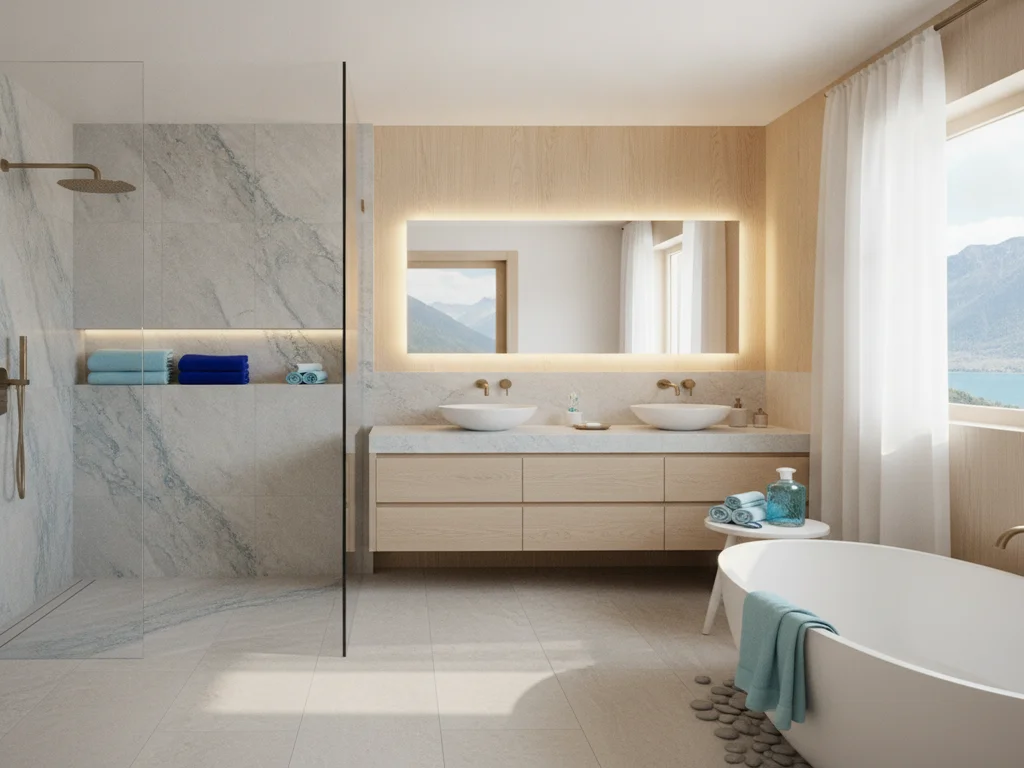
None of these features works in isolation — the steam shower's humidity load affects the ventilation plan, the heated floor has to be sequenced with the waterproofing membrane, and the stone selection has to account for both. That's the actual work of a master bathroom retreat in Camas: coordinating the tub placement, the steam generator sizing, the radiant floor, and the stone and tile plan into one system instead of a list of upgrades bolted onto an existing layout. For the mill-era homes downtown, the same principles apply at a smaller footprint; for a Prune Hill or Lacamas Lake primary suite with real square footage and a view already in hand, they're usually the difference between a nice bathroom and an actual retreat.
If steam and humidity are part of the plan, it's worth reading how that interacts with our marine climate more broadly — see our moisture control guide for marine-climate bathrooms for the ventilation side of the equation, and bathroom remodel cost guide for a primary suite in Camas for what a project like this typically involves budget-wise.
Ready to plan your Clark County bathroom?
Licensed & insured · 3-year workmanship warranty
Frequently asked questions
- How is a steam shower generator sized?
- Mr. Steam sizes residential generators to the enclosure's cubic volume — length times width times height — with adjustments for ceiling height over 96 inches and for non-porous materials like acrylic, which typically need less capacity than a ceramic-tile enclosure of the same size. Getting this wrong is the most common reason a steam shower never reaches a satisfying temperature.
- Do I need special waterproofing for a steam shower versus a regular shower?
- Yes. TCNA installation methods SR613 and SR614 call for a membrane meeting ANSI A118.10 that is specifically rated by its manufacturer for steam-room use. A standard shower membrane is not automatically rated for the sustained vapor exposure of a steam room, and gypsum wallboard should not be part of the assembly.
- Is heated bathroom floor actually more energy-efficient, or just more comfortable?
- Both. Per the U.S. Department of Energy, radiant heating is generally more efficient than baseboard heating and usually more efficient than forced-air heating because it eliminates duct losses. It's a genuine efficiency upgrade in addition to the comfort of a warm floor in a marine climate.
- Does a rainfall head with body sprays use a lot more water?
- It can, if each fixture isn't chosen carefully. EPA WaterSense-labeled showerheads are capped at 2.0 gallons per minute versus a 2.5 gpm standard head, but a multi-head system multiplies whatever each head uses. Speccing WaterSense-rated heads throughout, and adding diverter valves so every head isn't necessarily running at once, keeps the spa feel without an outsized water and heating load.
- Does natural stone hold up in a humid Camas bathroom?
- It can, with the right sealing plan. The Natural Stone Institute recommends a periodic penetrating sealer for stone in daily-use wet areas, and notes that calcareous stones like marble, travertine, and limestone need non-acidic cleaners, while siliceous stones like granite and quartzite are more tolerant. That maintenance plan needs to be part of the material decision up front, especially in a climate that stays damp much of the year.
Sources
- NKBA — Designing for Wellness: Kitchen and Bath Concepts That Support Self-Care
- Mr. Steam — Residential Steam Shower Guides & Specifications
- Tile Council of North America — Steam Rooms (SR613/SR614 FAQ)
- Natural Stone Institute — Caring for Natural Stone
- U.S. Department of Energy — Radiant Heating
- U.S. EPA WaterSense — Showerheads
Claims and figures are drawn from the sources above and provided for general guidance; your project may vary. Photography is illustrative of design concepts. For a fixed price on your specific bathroom, request a free estimate.