
Updated July 12, 2026 · 9 min read
The short answer
A Clark County bathroom stays dry by hitting three targets at once: indoor relative humidity kept below 60% (ideally 30–50%, per EPA), an exhaust fan sized and run long enough to actually clear that moisture (per HVI and Washington code), and materials plus a vapor strategy that let the assembly dry rather than trap water inside the wall.
Key takeaways
- EPA guidance is to keep indoor relative humidity below 60%, ideally between 30–50% — the range within which mold generally cannot establish itself.
- Washington code (WAC 51-51-1505) requires bathroom exhaust ducted directly outdoors at minimum 50 cfm intermittent or 20 cfm continuous; HVI recommends sizing to 1 cfm per square foot (or per-fixture for larger bathrooms) and running the fan roughly 20 minutes after use.
- Building Science Corporation's guidance is to avoid "double vapor barriers" — an assembly needs at least one direction it can dry toward, which is a real design decision in the Pacific Northwest's mixed-humid, marine climate.
- Because outdoor air here stays damp for a large share of the year, opening a window does far less work than it does in a dry climate — mechanical exhaust that pushes air fully outside (never into an attic or crawlspace) is what actually removes the moisture.
- Mold does not need a species ID to matter for your health: CDC does not recommend testing to decide whether to act, because reactions vary person to person and any mold found should be removed.
- Drying water-damaged materials within 24–48 hours prevents most mold growth from ever starting, per EPA — the fastest and cheapest intervention available.
Why a marine climate changes the math
Clark County sits in a marine west coast climate: the Columbia Gorge and Pacific weather systems keep outdoor air damp for a large share of the year, especially from fall through spring, with long stretches of overcast, drizzle, and elevated ambient humidity. That matters for a bathroom in a specific, practical way — in a dry climate, cracking a window or door for a few minutes does real work pulling moisture out of a room. Here, outdoor air is often already carrying significant moisture of its own, so it can't act as a passive dryer the way it can elsewhere.
That single fact reorders the priority list. A bathroom built for this climate leans harder on mechanical exhaust that pushes air fully outside, on assemblies that can dry in at least one direction when they do get wet, and on surfaces that tolerate sustained dampness rather than just resisting a splash. None of that is exotic engineering — it's the same building science used everywhere, applied with the humidity math run for our actual climate instead of a generic national average.
The humidity target, and why it is a range, not a single number
The EPA is direct about the number that matters most: keep indoor relative humidity below 60%, ideally between 30% and 50%. That range isn't arbitrary — mold requires sustained moisture to establish and spread, and humidity kept in that band generally denies it the conditions to take hold. Oregon State University Extension's healthy-homes guidance lands in the same place, recommending humidity be kept below 50% using air conditioning or a dehumidifier where needed — consistent, cross-border guidance for the same Pacific Northwest air.
A bathroom is the hardest room in the house to hold in that range, because a single shower can dump several pints of water into the air in minutes, spiking local RH well above 90% even when the rest of the home sits comfortably at 40%. The goal isn't to prevent that spike — it's physically unavoidable — it's to bring the room back down into range quickly, which is a ventilation problem as much as a humidity problem.
The other EPA number worth remembering
EPA guidance is that materials dried within 24–48 hours of getting wet generally do not develop mold. That window is the practical reason a bathroom needs to actually dry out after every use, not just look dry on the surface.
Ventilation: sizing the fan and actually running it
Washington's adopted mechanical code sets the floor: under WAC 51-51-1505, bathrooms need a local exhaust system ducted directly to the outdoors — never into an attic or crawlspace — rated for at least 50 cfm on intermittent operation or 20 cfm if it runs continuously, with a backdraft damper and a manual or automatic control (switch, timer, or humidity sensor).
The Home Ventilating Institute sizing guidance goes a step further than the code minimum: for bathrooms up to 100 square feet, size the fan to 1 cfm per square foot (with a 50 cfm floor for anything 50 square feet or smaller); for larger bathrooms, size per fixture — 50 cfm each for a toilet, shower, or tub, and 100 cfm for a jetted tub. HVI also recommends running the fan for roughly 20 minutes after the bathroom is used, not just while someone's in the shower, since that's the window in which most of the airborne moisture actually clears the room. A timer switch enforces that automatically, which matters most in winter, when the temptation to shut the fan off the moment the shower ends is strongest.
- Fan capacity: HVI 1 cfm/sq ft (100 sq ft and under) or per-fixture sizing for larger bathrooms; WA code minimum is 50 cfm intermittent / 20 cfm continuous.
- Duct path: straight to the exterior with a backdraft damper — routing exhaust into an attic or crawlspace just relocates the moisture problem.
- Run time: roughly 20 minutes after use (HVI); a timer or humidity-sensing control makes this automatic instead of relying on memory.
- Placement: exhaust point located over or near the shower/tub, with an enclosed toilet area getting its own coverage.
Vapor management: which direction the wall needs to dry
This is the piece that's easiest to get backward. Building Science Corporation frames moisture control around three complementary strategies: control moisture entry, control moisture accumulation, and — critically — allow moisture that does get in to dry out. Their guidance is explicit that an assembly needs to be able to dry in at least one direction, and that stacking two vapor barriers on opposite sides of the same wall (a genuine mistake, not a theoretical one) can trap moisture with nowhere to go.
In the Pacific Northwest's mixed-humid, marine climate, that means being deliberate about where a vapor retarder goes relative to the shower's waterproofing membrane, rather than defaulting to whatever a warmer or drier region would use. The shower membrane itself — covered in detail in our shower waterproofing guide — is the first line of defense against bulk water; the vapor strategy in the surrounding wall assembly is what keeps water vapor from condensing inside a cavity it can't escape. Building Science Corporation also points to controlled mechanical ventilation, sized to ASHRAE Standard 62.2, as the complement to vapor control — the two work together rather than substituting for each other.
Surfaces that actually hold up to sustained humidity
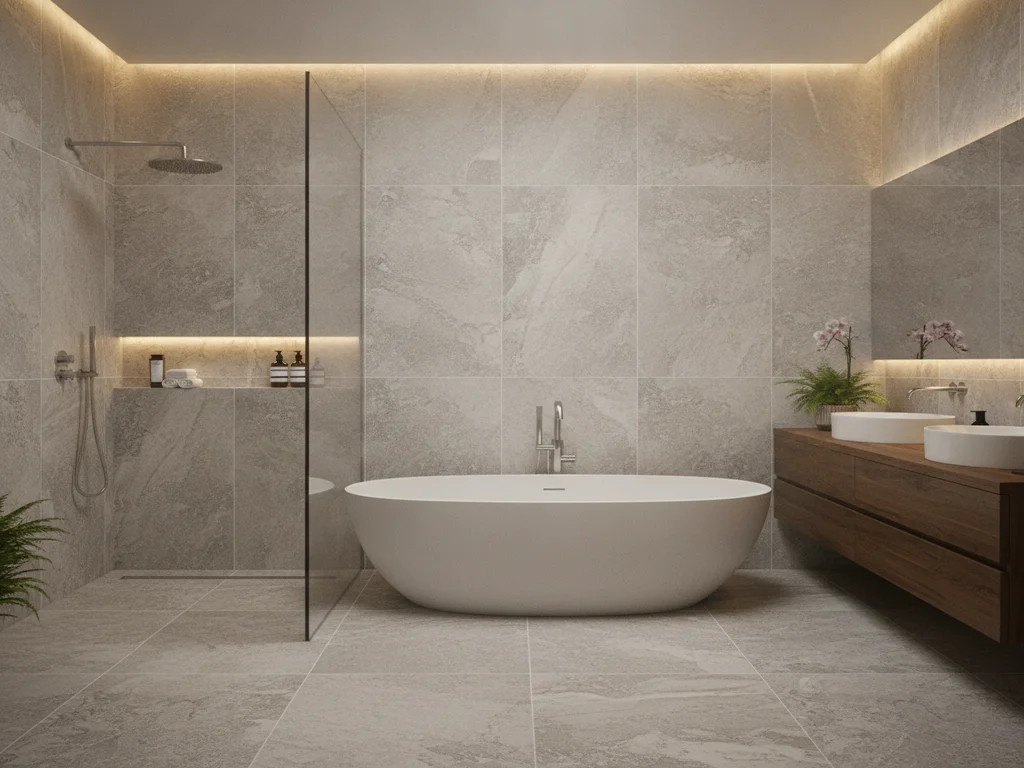
Waterproofing and ventilation handle the moisture a bathroom generates; surface material determines how well the room tolerates the humidity that's left over after both are working correctly. Dense, low-porosity materials — porcelain tile, natural stone sealed appropriately for its porosity, solid-surface countertops — resist the sustained dampness of a marine climate better than porous or organic-faced materials, which give mildew something to establish on even when bulk water isn't present.
Grout choice and joint design matter as much as the tile itself: a well-sealed, appropriately narrow grout joint gives mildew far less surface area to colonize than a wide or degraded one. Our best bathroom materials for the PNW climate guide goes deeper on which specific products perform well here, and bathroom fixture care and tile and grout care cover the maintenance habits — squeegeeing glass, wiping down grout lines, resealing on schedule — that keep those materials performing at their rated level for years instead of degrading early.
Drainage: getting water to the drain, not just off the surface
A surface can be perfectly waterproof and still leave a bathroom chronically damp if water doesn't actually reach a drain. Shower pans need real slope toward the drain — not just a visually level-looking floor — and a wet-room layout, where the whole floor is a single sloped waterproof plane, takes that principle further by managing water across the entire room rather than containing it behind a curb.
That's a meaningfully different design problem than a standard shower, and it's why a wet room conversion in Camas gets engineered around slope, drain placement, and membrane continuity from the start rather than retrofitted onto an existing layout. Curbless shower installations carry the same drainage requirements as a standard shower pan — they just spread the waterproofing further across the room.
Why this is a health issue, not just a maintenance one
Getting moisture control wrong isn't only a durability problem for the bathroom itself. CDC guidance describes mold exposure as capable of causing a stuffy nose, sore throat, coughing or wheezing, burning eyes, or skin rash in some people, with more severe reactions among those who have asthma or a mold allergy. CDC does not recommend testing to identify which species is present, because health effects vary from person to person regardless of species — its guidance is simply to remove mold once it's found, rather than spend time and money determining what kind it is first.
ASHRAE's position document on limiting indoor mold and dampness makes the same point at the building-science level: persistent dampness contributes to negative health outcomes for occupants, and preventing it requires decisions that span design, construction, and ongoing operation — not a single fix applied once and forgotten. That's the underlying reason humidity targets, fan sizing, vapor strategy, and material choice all belong in the same conversation rather than four separate ones.
Warning signs worth acting on immediately
A musty smell that doesn't clear, discoloration at grout lines or ceiling corners, peeling paint near the shower, or condensation that lingers on mirrors and windows long after a shower are all signs the room isn't drying out fast enough. Per EPA, addressing the source within 24–48 hours of any water event is what actually prevents mold from establishing.
How Camas Bath approaches this on every project
Because humidity control here depends on the fan, the vapor strategy, and the surface material all working together, we plan for our marine climate specifically rather than defaulting to a generic spec — right-sizing exhaust ventilation to the room and fixture mix, sequencing waterproofing and vapor management so the assembly can actually dry, and specifying grout and surface materials that hold up to sustained humidity. That approach applies across full bathroom remodeling in Vancouver and every other project we build across Clark County.
Ready to plan your Clark County bathroom?
Licensed & insured · 3-year workmanship warranty
Frequently asked questions
- What humidity level should a bathroom stay at to prevent mold?
- EPA guidance is to keep indoor relative humidity below 60%, ideally between 30% and 50%. A shower will temporarily spike a bathroom's humidity well above that range — the goal is bringing it back down into range quickly through ventilation, not preventing the spike itself.
- How big of an exhaust fan does a bathroom need?
- Washington code (WAC 51-51-1505) sets a floor of 50 cfm on intermittent operation or 20 cfm continuous, ducted directly outdoors. The Home Ventilating Institute recommends sizing to 1 cfm per square foot for bathrooms up to 100 square feet (minimum 50 cfm), or per-fixture sizing — 50 cfm each for a toilet, shower, or tub, 100 cfm for a jetted tub — for larger bathrooms.
- How long should a bathroom exhaust fan run after a shower?
- The Home Ventilating Institute recommends running the fan for roughly 20 minutes after the bathroom is used, since that's the window in which most airborne moisture actually clears the room. A timer switch or humidity-sensing control makes this consistent instead of relying on someone remembering to leave it on.
- Why does our marine climate make bathroom moisture control harder?
- Outdoor air in Clark County stays damp for a large share of the year, so it can't passively dry a room out the way it can in an arid climate. That shifts more of the work onto mechanical exhaust that pushes air fully outside, an assembly that can dry in at least one direction if it gets wet, and surfaces that tolerate sustained dampness rather than just resisting a quick splash.
- Do I need to test for mold before removing it?
- No. CDC does not recommend mold testing to decide whether to act, because health effects vary from person to person regardless of which species is present. Its guidance is to remove mold once it's found and, more importantly, to fix the moisture source that let it grow in the first place.
Sources
- U.S. EPA — A Brief Guide to Mold, Moisture and Your Home
- CDC — Mold and Health
- Building Science Corporation — BSD-012: Moisture Control for New Residential Buildings
- Oregon State University Extension Service — Mold Control: Home Inspection Checklist
- ASHRAE — Position Document on Limiting Indoor Mold and Dampness in Buildings
- Home Ventilating Institute — Bathroom Ventilation Guidance
- Washington State Legislature — WAC 51-51-1505 (Mechanical Ventilation)
Claims and figures are drawn from the sources above and provided for general guidance; your project may vary. Photography is illustrative of design concepts. For a fixed price on your specific bathroom, request a free estimate.