Published · Updated · 6 min read
By Camas Bath
The short answer
A center (point) drain needs the shower floor sloped from all directions toward it, which limits the floor to small tiles that can follow the slope. A linear drain slopes the floor in a single plane toward one edge, so large-format tile can run from the bathroom onto the shower floor. In Washington, either must meet the 2-inch minimum drain size (UPC, WAC 51-56).
The drain is the least visible decision in a shower and one of the most consequential. It sets how the floor is sloped, which in turn sets what tile can go on it and whether a curbless entry is practical.
There are two main families. A center or point drain is the familiar round or square grate in the middle of the floor. A linear drain is a long, narrow channel, usually along a wall or at the shower entry.
Key facts
- Washington requires a shower waste outlet at least 2 inches in diameter; 1½ inches is allowed only where an existing tub is replaced by a shower, a 2-inch waste is not readily available, the building official approves and there is one 1.8 gpm showerhead (WAC 51-56-0400, Sec. 408.4).
- Fine Homebuilding priced a conventional clamp-style shower drain at about $15 and a 30-inch linear drain at $100 to $300 or more (2012 prices) (Fine Homebuilding).
- This Old House lists a shower drain at $400–$500 installed and a typical shower remodel at $8,500–$10,000 (updated June 2026) (This Old House).
- Washington limits showerheads to 1.8 gallons per minute at 80 psi, whichever drain the shower uses (WAC 51-56-0400, Sec. 408.2).
Key takeaways
- A center drain needs a four-way slope; a linear drain needs a single-plane slope.
- The single-plane slope lets large-format tile run onto the shower floor and suits curbless showers.
- A linear drain part costs more — Fine Homebuilding cited $100 to $300+ for 30 inches vs about $15 for a clamp-style drain.
- Washington requires a 2-inch shower drain and a finished floor slope of 1/8 to 1/2 inch per foot, whichever type you use.
What is the difference between a linear drain and a center drain?
Schluter, which makes both types, explains it directly: with a point drain, the shower base must be sloped from all directions to the drain. That four-way slope creates valleys and ridges across the floor, and the tile has to bend with them, which limits the floor to smaller tile formats.
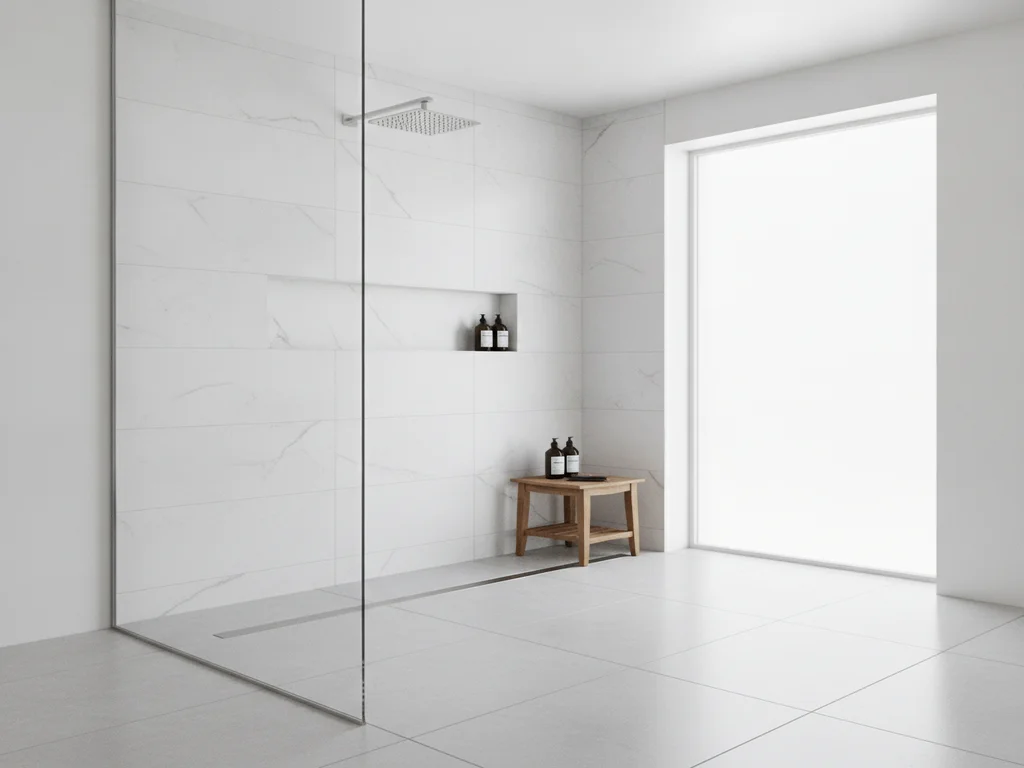
With a linear drain, the shower base can be sloped on a single plane, like a ramp tilting toward one edge. A flat plane can take large tiles without cutting them into a pattern of triangles, so Schluter notes that large-format tile used on the bathroom floor can be continued onto the shower base.
Side-by-side comparison
| Center / point drain | Linear drain | |
|---|---|---|
| Floor slope | From all directions toward the drain | Single plane toward one edge |
| Floor tile | Small formats (e.g. mosaics) that follow the slope | Large-format tile can run continuously |
| Curbless showers | Possible, but the four-way slope needs depth in every direction | Well suited — the slope runs one way, often toward a wall |
| Part cost (Fine Homebuilding) | About $15 for a conventional clamp-style drain | $100 to $300 or more for a 30-inch drain |
| Code minimum size (Washington) | 2-inch drain | 2-inch drain |
Sources: Schluter Systems; Fine Homebuilding (part prices, 2012 — treat as relative, not current); WAC 51-56 / 2021 UPC 408.4.
How much does a linear drain cost compared with a center drain?
Fine Homebuilding compared the parts: a conventional clamp-style shower drain costs about $15, while a 30-inch linear drain can sell for $100 to $300 or more. Those prices date from 2012, so read them as a ratio rather than a current price list — the linear drain itself is the more expensive part.
This Old House’s 2026 shower remodel cost guide lists a shower drain at $400 to $500 installed, without separating drain types. In practice the larger cost difference is often not the drain but the floor: a linear drain in a curbless shower usually comes with a recessed subfloor and extended waterproofing, covered in our curbless shower cost guide.
What size shower drain does Washington require?
Washington’s version of the Uniform Plumbing Code (WAC 51-56-0400) requires a shower drain at least 2 inches in diameter, with a narrow exception allowing 1½ inches in some tub-to-shower conversions if the building official approves. The finished floor must slope toward the drain at between 1/8 and 1/2 inch per foot. Both rules apply whichever drain type you choose.
For curb, liner and curbless rules, see our guide to the shower curb height code in Washington.
Which shower drain should you choose?
- Choose a linear drain if you want large-format tile on the shower floor, a curbless entry, or a floor that reads as one continuous surface with the rest of the bathroom.
- A center drain is the simpler, lower-cost part and suits a curbed shower with mosaic or small-format floor tile.
- If the existing drain is in the center and the remodel keeps the layout, staying with a center drain avoids relocating the drain line.
- Moving a drain, or switching types, changes plumbing and generally needs a plumbing permit.
How Camas Bath handles this
We choose the drain together with the floor tile and entry type at the design stage, because the three decisions depend on each other. Drain relocation and pan work are permitted and inspected before tile goes down.
Frequently asked questions
- Is a linear drain better than a center drain?
- A linear drain is not universally better than a center drain. A linear drain allows a single-plane floor slope, which suits large-format tile and curbless showers. A center drain is a simpler, cheaper part that works well in a curbed shower with small-format floor tile.
- Can you use large tiles with a center drain?
- Large tiles are limited with a center drain. Schluter notes that point drains require the floor to be sloped from all directions, which limits the floor to smaller tile formats that can follow the slope.
- What size shower drain does Washington require?
- Washington requires a shower drain at least 2 inches in diameter under WAC 51-56. A 1½-inch drain may be allowed where an existing tub is replaced by a shower and a 2-inch waste is not readily available, with the building official’s approval and a single showerhead of 1.8 gpm or less.
Sources
- Schluter Systems — Shower with linear drain
- Fine Homebuilding — Linear Drains for Custom Showers
- This Old House — Shower Remodel Cost (2026)
- WAC 51-56-0400 — Washington amendments to UPC chapter 4
- IAPMO — 2021 Uniform Plumbing Code (free online viewer)
Claims and figures are drawn from the sources above and provided for general guidance; your project may vary. For a fixed price on your specific bathroom, request a free estimate.