Updated July 12, 2026 · 8 min read
The short answer
Camas runs its own municipal system — 10 groundwater wells feeding city reservoirs, tested annually and reported in a public Consumer Confidence Report. Outlying Clark County properties on private wells get no ongoing state monitoring after initial construction testing. Both can carry dissolved minerals that affect glass, tile, and fixture finishes over time — the fix is knowing your actual water and choosing accordingly, not guessing.
Key takeaways
- Camas's municipal water is 100% groundwater — 10 city wells drawing from the Jones/Boulder Watershed Area, treated and stored in 8 reservoirs, per the City of Camas Public Works Department.
- The City of Camas publishes an annual Consumer Confidence Report (Water Quality Report) with actual test results for its system — that report, not a national average, is the real answer to "how hard is Camas water."
- USGS classifies water hardness by dissolved calcium and magnesium: soft (0–60 mg/L), moderately hard (61–120), hard (121–180), very hard (over 180, all as calcium carbonate).
- Outside Camas city limits, Washington splits water supply into three tiers with very different oversight: Group A systems (15+ connections) carry full Safe Drinking Water Act monitoring; Group B systems (under 15 connections) get lighter, largely one-time oversight; roughly 725,000 Washington residents on individual private wells are regulated only by local health jurisdictions, mainly at construction.
- A private well in unincorporated Clark County is tested once, for coliform bacteria, arsenic, and nitrate, before the property is occupied — after that, ongoing testing is the owner's responsibility, not a requirement, per Clark County Public Health.
- EPA's secondary (aesthetic, non-health) standards flag exactly the substances that show up as bathroom problems: total dissolved solids over 500 mg/L for hardness and deposits, iron over 0.3 mg/L for reddish staining, and manganese over 0.05 mg/L for black staining.
Camas is one water system; the hills around it are not
Inside Camas city limits, everyone is on the same municipal system: 10 groundwater wells feeding the City of Camas system, treated in the Jones/Boulder Watershed Area, and stored across 8 reservoirs before it reaches a tap. That's a single, tested, publicly reported source — the same water whether a house sits in downtown Camas near the mill-era core or up in a newer Prune Hill or Grass Valley subdivision, as long as the address is inside city limits.
Step outside those limits — into unincorporated pockets of Clark County that ring the city — and the picture changes. Some outlying properties sit on a small shared Group B system; many are on a single private well serving one house. Neither carries the same ongoing testing regime as Camas's municipal supply, which matters for anyone planning fixtures, glass, or tile for a bathroom fed by one.
What Camas's own water quality report actually says
The City of Camas publishes an annual Water Quality Report (Consumer Confidence Report), as Washington's Department of Health requires of every municipal system. It's the actual test data for Camas's specific wells — not a generic regional estimate — and it's the right place to look up current hardness, mineral content, and any detected substances for the address you're remodeling.
That's worth doing before finalizing fixture finishes, because "Camas water" isn't a single fixed number year to year — groundwater chemistry shifts modestly with season and well rotation. The CCR is the source of record; treat any number quoted secondhand (including general regional averages) as a starting point, not a substitute for the current report.
This article is about supply, not humidity
Water hardness and mineral content are a plumbing and finish-selection issue. If you're dealing with condensation, mold, or ventilation in a Clark County bathroom, that's a separate topic covered in our marine climate moisture control guide.
What "hard water" actually measures
Hardness is dissolved calcium and magnesium, picked up as groundwater moves through soil and rock before it reaches a well or wellfield. USGS classifies it on a standard scale, measured as calcium carbonate: soft is 0–60 mg/L, moderately hard is 61–120 mg/L, hard is 121–180 mg/L, and very hard is anything above 180 mg/L. USGS is also direct about why it matters for a house: heated hard water forms solid calcium carbonate deposits — scale — inside water heaters and fixtures, which reduces equipment life, raises water-heating costs, and can gradually narrow pipe diameter.
Hardness itself isn't a health standard — the EPA doesn't regulate it as a contaminant because calcium and magnesium aren't harmful to drink. It's classified instead under EPA's secondary, aesthetic-only guidelines, alongside the other substances that actually show up as bathroom problems.
The substances that actually stain a bathroom
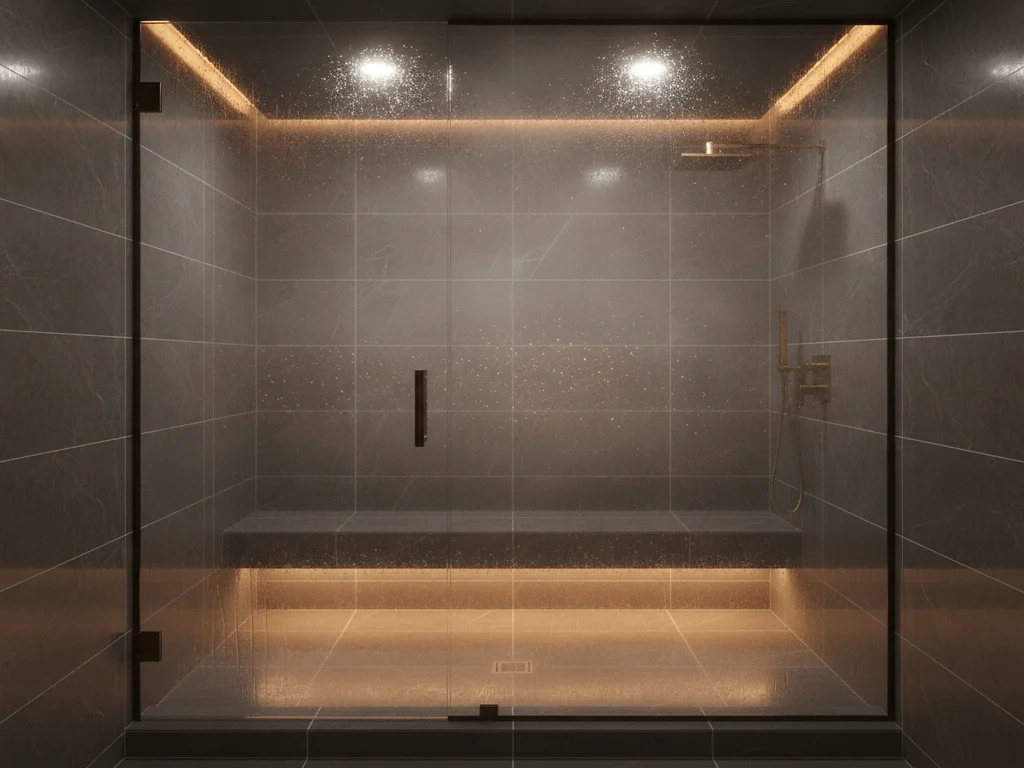
This is the detail worth knowing before picking finishes: hardness (calcium and magnesium) causes scale and film, but it's usually iron and manganese — not calcium — that cause visible staining. EPA's Secondary Drinking Water Standards lay out the specific thresholds, none of them health-based, all of them aesthetic:
| Substance | Guideline level | What it looks like in a bathroom |
|---|---|---|
| Total dissolved solids (hardness-related) | 500 mg/L | Deposits, colored water, scale on fixtures and glass |
| Iron | 0.3 mg/L | Reddish-orange staining on tile, grout, and porcelain |
| Manganese | 0.05 mg/L | Black-to-brown staining, similar pattern to iron but darker |
| pH | 6.5–8.5 (target range) | Low pH: metallic taste, fixture corrosion. High pH: slippery feel, mineral deposits |
These are EPA's non-enforceable Secondary Maximum Contaminant Levels (SMCLs) — set for taste, appearance, and nuisance effects, not health risk. Actual levels for a given address come from the water system's own testing.
If your bathroom runs on a private well
Roughly 725,000 Washington residents get their water from an individual private well, and per the WA Department of Health, those wells are regulated only by local health jurisdictions — with far less structured oversight than a Group A municipal system like Camas's. In Clark County specifically, Clark County Public Health requires new and replacement wells to be tested once, for coliform bacteria, arsenic, and nitrate, before a home is occupied. After that, testing is the owner's responsibility, not an ongoing requirement.
That gap matters for a bathroom remodel specifically because mineral content and hardness aren't part of that one-time construction test — coliform, arsenic, and nitrate are health-focused, not aesthetic-focused. A private well can be perfectly safe by that test and still run hard, iron-rich, or high in manganese in ways that will show up on glass and tile within a year. WA DOH recommends well owners test annually for coliform and nitrate, and periodically for arsenic — adding a hardness and mineral panel to that same lab order is a small cost next to a bathroom remodel budget, and it's the only way to actually know what a Grass Valley-edge or rural Clark County well is putting into a new shower.
- One-time construction test (required): coliform bacteria, arsenic, nitrate.
- Not included, but worth adding before finishing selection: total hardness, iron, manganese, pH, TDS.
- A WA-certified lab can typically run all of the above from a single water sample.
How this should actually change fixture and finish choices
Knowing whether a bathroom sits on Camas's municipal supply or an untested private well should shape three decisions, not zero:
- Shower glass: frameless glass shows mineral film faster than almost any other surface. A quality anti-etch or hydrophobic glass coating, plus routine squeegeeing, matters more on harder or mineral-heavier water — our shower glass care guide covers the maintenance side once the glass is installed.
- Fixture finish and mechanism: some plumbing fixture finishes and cartridge designs tolerate scale buildup better than others over years of hard-water exposure. This is a conversation to have with whoever specifies fixtures once you know your actual hardness number, not a generic upgrade — routine upkeep from our bathroom fixture care guide helps regardless of finish.
- Tile, grout, and stone: iron and manganese staining shows up in grout lines and on light-colored stone first. Sealed, low-porosity materials and darker or more forgiving grout colors are a practical hedge on a well with unknown mineral content — see custom tile & stone work in Camas for material options suited to it.
How Camas Bath approaches this
Because a bathroom's water source is easy to overlook until stains or scale show up years in, we ask early whether a project is on Camas municipal water or a private well, and factor the answer into fixture, glass, and finish recommendations as part of a full bathroom remodel in Camas — pointing well-sourced projects toward a mineral panel test before finish selection, and pulling the current Camas Consumer Confidence Report for municipal projects, rather than assuming either one.
Ready to plan your Clark County bathroom?
Licensed & insured · 3-year workmanship warranty
Frequently asked questions
- Is Camas, WA municipal water hard?
- The City of Camas publishes an annual Consumer Confidence Report with current test results for its 10-well groundwater system — that report is the accurate source for a specific hardness reading, since groundwater chemistry can shift modestly year to year. USGS classifies hardness as soft (0–60 mg/L), moderately hard (61–120), hard (121–180), or very hard (over 180), all measured as calcium carbonate.
- What's the difference between Group A, Group B, and a private well in Clark County?
- Group A systems serve 15 or more connections or 25+ people for 60+ days a year and carry full Safe Drinking Water Act monitoring — Camas's municipal system is a Group A system. Group B systems serve fewer than 15 connections with lighter, largely one-time oversight. Private wells serve a single home and are regulated only by the local health jurisdiction, mainly through a one-time test at construction.
- Does my private well get tested for hardness or minerals automatically?
- No. Clark County requires new and replacement wells to be tested once, before occupancy, for coliform bacteria, arsenic, and nitrate — a health-focused panel. Hardness, iron, manganese, and pH are not part of that required test. WA Dept. of Health recommends annual coliform/nitrate testing after that, and adding a hardness/mineral panel is a separate, optional step worth taking before a bathroom remodel.
- What actually stains bathroom fixtures and tile — hardness or something else?
- Hardness (calcium and magnesium) mainly causes scale and glass film. Visible staining — reddish-orange or black-brown — usually comes from iron or manganese, per EPA's secondary drinking water guidelines. A water test that reports hardness but not iron/manganese is missing the substances most likely to discolor tile and grout.
- Should fixture finish selection be different for hard or mineral-heavy water?
- It's worth a conversation with whoever specifies your fixtures once you know your actual test results. Frameless shower glass, in particular, benefits from an anti-etch or hydrophobic coating on harder or mineral-heavier supplies, and sealed, low-porosity tile/stone with a durable grout choice is a practical hedge on any well with unknown mineral content.
Sources
- City of Camas — Water Services (municipal water source)
- City of Camas — Water Quality Reports (Consumer Confidence Reports)
- USGS — Hardness of Water
- U.S. EPA — Secondary Drinking Water Standards: Guidance for Nuisance Chemicals
- WA Department of Health — Group B Public Water Systems (General Information)
- WA Department of Health — Testing Your Water (private wells)
- Clark County, WA — Individual Water Systems (Public Health)
Claims and figures are drawn from the sources above and provided for general guidance; your project may vary. Photography is illustrative of design concepts. For a fixed price on your specific bathroom, request a free estimate.