Published · Updated · 7 min read
By Camas Bath
The short answer
A Washington bathroom remodel is governed by the 2021 Uniform Plumbing Code as amended by WAC 51-56, the 2023 National Electrical Code as adopted by L&I, the state’s lead-safe renovation rule for pre-1978 homes, SWCAA 476 for asbestos in Clark County, and local building permits. Sales tax applies to the full contract price.
A common source of confusion is that national remodeling advice quotes the International Residential Code (IRC) for everything. Washington adopts the IRC for building work, but it regulates plumbing under the Uniform Plumbing Code and electrical work under the National Electrical Code, each with Washington amendments. This page is a short reference to which rule covers what, with links to the detailed guides.
Key facts
- Washington adopts the International Residential Code for building work but not its chapters 11 and 25 through 43, so plumbing is not regulated by the IRC (WAC 51-51-003).
- Washington caps toilets at 1.28 gallons per flush, showerheads at 1.8 gpm at 80 psi and residential bathroom faucets at 1.2 gpm at 60 psi (WAC 51-56-0400).
- Washington enforces the 2023 National Electrical Code, and the 2026 edition replaces it effective December 31, 2026 (WAC 296-46B-010).
- Washington’s lead-safe renovation rule covers target housing, defined as housing built before 1978 (WAC 365-230).
- Clark County’s asbestos rule, SWCAA 476, took effect in its current form on March 22, 2026 (SWCAA 476).
Key takeaways
- Plumbing in Washington follows the 2021 UPC with WAC 51-56 amendments, not the IRC.
- Washington fixture limits: 1.28 gpf toilets, 1.8 gpm showerheads, 1.2 gpm bathroom faucets.
- Electrical follows the 2023 NEC through WAC 296-46B until the 2026 NEC takes over on December 31, 2026.
- Lead rules apply to pre-1978 homes; Clark County’s asbestos rule applies to homes of any age.
- Sales tax applies to the whole remodel at the job-site rate and is stated separately.
Which code covers which bathroom work in Washington?
| Work | Code or rule | Who enforces it in Clark County |
|---|---|---|
| Plumbing: showers, drains, toilets, valves | 2021 Uniform Plumbing Code as amended by WAC 51-56 | City building department or Clark County |
| Walls, framing, structure | Washington’s adoption of the IRC (WAC 51-51-003), plumbing chapters excluded | City building department or Clark County |
| Electrical | 2023 NEC as adopted by WAC 296-46B-010 (2026 NEC from Dec. 31, 2026) | L&I, or the City of Vancouver inside its limits (L&I city list) |
| Lead paint, homes built before 1978 | WAC 365-230 (Washington RRP program) | Washington Department of Commerce |
| Asbestos, homes of any age | SWCAA 476; WAC 296-62-07721 | Southwest Clean Air Agency; L&I |
| Sales tax | WAC 458-20-170; RCW 82.08.050 | Washington Department of Revenue |
What does Washington require for showers and drains?
- Curb: 2 to 9 inches from the top of the curb to the top of the drain (UPC 408.5).
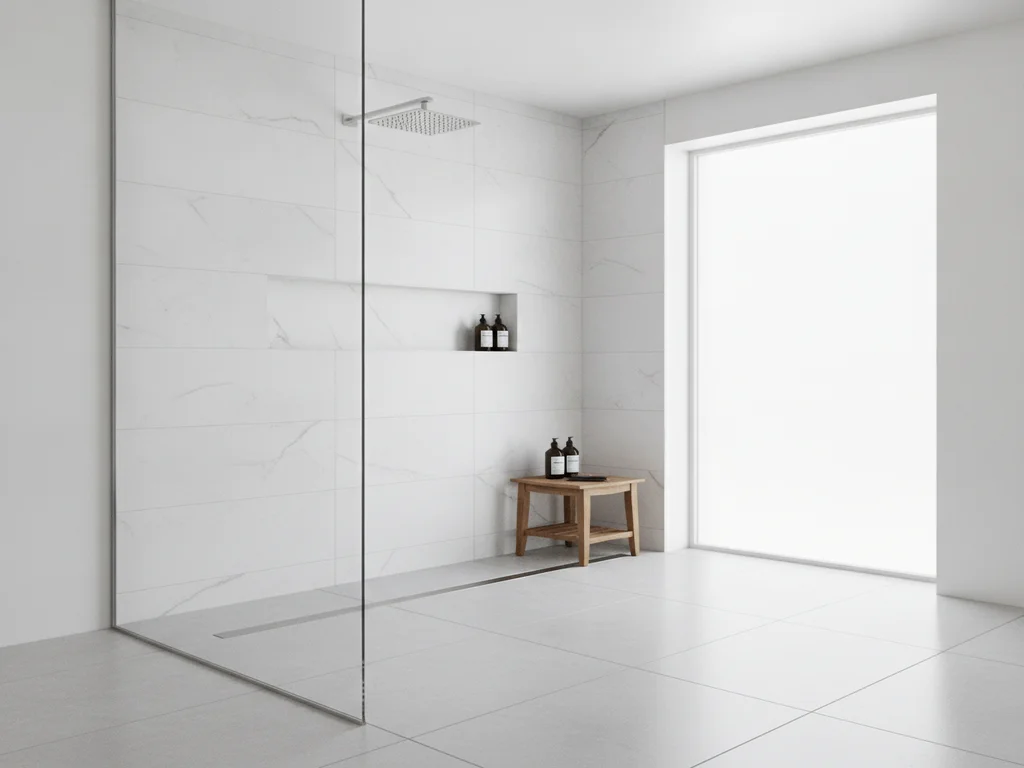
- Curbless showers are allowed for accessible designs; the rest of the room floor then counts as a wet location.
- Minimum shower: 900 square inches plus a 30-inch circle — a Washington amendment (WAC 51-56-0400) to the model code’s 1,024.
- Finished floor slope 1/8 to 1/2 inch per foot; liner sloped 1/4 inch per foot and turned up 3 inches above the finished curb.
- Shower drain: 2 inches minimum, with a narrow 1½-inch exception for some tub-to-shower conversions.
- Details: shower curb height code and linear vs. center drains.
What are Washington’s bathroom fixture flow limits?
Washington’s plumbing amendments in WAC 51-56-0400 set flow limits stricter than federal law and, for showerheads and faucets, stricter than the WaterSense label. Details: WaterSense and Washington fixture limits.
| Fixture | Washington limit |
|---|---|
| Toilet | 1.28 gallons per flush; must meet WaterSense high-efficiency criteria |
| Showerhead | 1.8 gpm at 80 psi; outlets on one valve 1.8 gpm combined unless only one runs at a time |
| Bathroom faucet | 1.2 gpm at 60 psi (0.8 gpm minimum at 20 psi) |
Source: WAC 51-56-0400 (UPC 407.2, 408.2, 411.2 as amended).
What do Washington shower valves have to do?
Every shower and tub-shower needs an individual pressure-balance, thermostatic or combination valve providing scald and thermal shock protection (UPC 408.3). Water from a showerhead is limited to 120°F (408.3.2), and so is water from a bathtub filler (409.4). Details: shower valve types and code.
Electrical
- GFCI protection for bathroom receptacles (NEC 210.8(A)(1)); Washington adds GFCI for fixed equipment with exposed grounded metal parts in an enclosed shower or within 5 feet of a tub (WAC 296-46B-210).
- At least one 20-amp circuit for bathroom receptacles (NEC 210.11(C)(3)).
- A receptacle within 3 feet of each sink; none within 3 feet of a tub or shower, up to 8 feet high (NEC 210.52(D), 406.9(C)).
- AFCI is not required for bathroom outlets in dwellings (NEC 210.12(B)).
- Electrical work needs a permit before it starts, and wiring cannot be covered until inspected.
- Details: bathroom electrical requirements in Washington.
Lead and asbestos
- Paid work disturbing paint in a pre-1978 home must be done by a firm certified by the Washington Department of Commerce; the interior minor-repair exemption is 6 square feet per room (WAC 365-230).
- In Clark County, suspect asbestos materials must be inspected by an AHERA-accredited inspector or treated as asbestos, in homes of any age; removal needs an SWCAA notice and usually a ten-day wait (SWCAA 476).
- Details: lead paint and asbestos in a Clark County remodel.
Permits and sales tax
- Plumbing and building permits come from the city (Camas, Vancouver, Washougal, Battle Ground, Ridgefield, La Center) or Clark County for unincorporated addresses — see the Clark County permit guide.
- Electrical permits come from L&I everywhere except inside Vancouver city limits.
- Sales tax applies to the full contract price, labor included, at the job-site rate (8.0% to 9.0% in Clark County) and must be stated separately — see Washington sales tax on a remodel.
Frequently asked questions
- Does Washington use the IRC for bathroom plumbing?
- No. Washington adopts the IRC for building work but excludes its plumbing chapters. Plumbing is regulated by the Uniform Plumbing Code as amended in chapter 51-56 WAC.
- What are the toilet and showerhead limits in Washington?
- Under WAC 51-56, installed toilets are limited to 1.28 gallons per flush and showerheads to 1.8 gallons per minute at 80 psi. Residential bathroom faucets are limited to 1.2 gallons per minute at 60 psi.
- Which electrical code applies to a Washington bathroom remodel?
- A Washington bathroom remodel follows the 2023 National Electrical Code as adopted by WAC 296-46B when the electrical permit is issued before December 31, 2026. For permits issued from that date, the 2026 edition applies.
Sources
- WAC 51-56 — Washington adoption of the 2021 Uniform Plumbing Code
- WAC 51-56-0400 — Washington amendments to UPC chapter 4
- WAC 51-51-003 — Washington adoption of the IRC
- IAPMO — 2021 Uniform Plumbing Code (free online viewer)
- WAC 296-46B-010 — Electrical code adoption
- WAC 296-46B-210 — Washington amendments to NEC Article 210
- WAC 365-230 — Washington lead-based paint rule
- SWCAA 476 — Asbestos control standards
- WAC 458-20-170 — Constructing and repairing buildings (sales tax)
- Washington L&I — City electrical permits and inspections
Claims and figures are drawn from the sources above and provided for general guidance; your project may vary. For a fixed price on your specific bathroom, request a free estimate.