Updated July 12, 2026 · 9 min read
The short answer
Older Washougal homes near downtown and the Columbia River riverfront typically carry three renodel-relevant issues: a mid-century bathroom layout sized for a single tub-shower and pedestal sink, original fixtures and surrounds nearing end of service life, and ventilation built to a lower standard than today's code in a climate that stays damp for a large share of the year. A respectful remodel updates what is behind the walls and widens the layout where it makes sense, while keeping the scale and character that make the house what it is.
Key takeaways
- Nationally, the median owner-occupied home is now 42 years old, and roughly 47% of owner-occupied homes were built before 1980 — NAHB data that helps explain why so much remodeling demand nationwide, and in older Washougal neighborhoods specifically, is driven by aging housing stock rather than new construction.
- Any home built before 1978 falls under EPA's Renovation, Repair and Painting (RRP) Rule — paid work that disturbs painted surfaces must be done using lead-safe practices by an EPA-certified renovator, a real legal requirement for a lot of downtown Washougal's housing.
- Galvanized steel supply piping, common in homes built before the 1960s, corrodes from the inside out over roughly a 40-50 year service life; This Old House notes older homes commonly still carry cast iron or galvanized piping that was never designed for today's fixtures or water pressure.
- A classic mid-century Washougal bathroom is often a single, narrow tub-shower unit with a fixed surround and minimal or no mechanical ventilation — a layout built well before today's exhaust-fan code requirements existed.
- Riverfront proximity does not change the building-science fundamentals, but it is one more reason to size ventilation correctly rather than assume an old bathroom fan (or an open window) is doing the job; our marine-climate moisture control guide covers the humidity targets and CFM math in detail.
- A City of Washougal building permit and a WA L&I-registered contractor are both required for the plumbing, electrical, and structural work a real older-home bathroom remodel typically involves — not just a courtesy step.
Why so much of older Washougal needs this conversation
Washougal grew up as a riverfront town on the Columbia, anchored by the historic Pendleton Woolen Mills, and the walkable blocks around downtown and the waterfront still carry a real concentration of mid-century homes — modest footprints, a single full bathroom, and, very often, original fixtures that have never been touched. That is a different renovation problem than the newer subdivisions rising toward the Gorge foothills, where the layout is usually fine and the upgrade is cosmetic.
It is not a Washougal-specific quirk that older homes need more than a cosmetic refresh — it is a national pattern. NAHB reports the median owner-occupied U.S. home is now 42 years old, up from 31 in 2005, and roughly 47% of owner-occupied homes were built before 1980. Downtown and riverfront Washougal's housing stock sits well inside that older cohort, which is exactly why bathroom remodels here so often turn into a conversation about what is behind the wall and under the tub, not just what is on the surface.
The layout: a mid-century footprint built for a different household
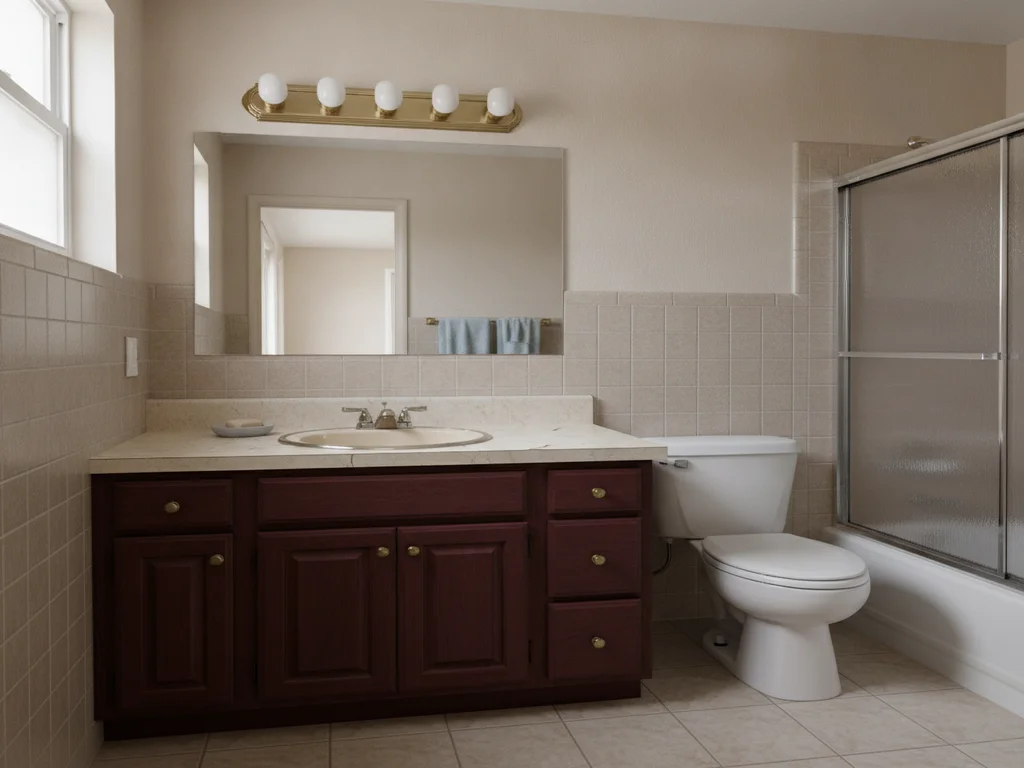
A lot of these bathrooms share the same bones: a narrow tub-shower combo along one wall, a compact vanity, and just enough floor space to turn around. It was a reasonable layout for the era, but it rarely matches how a household actually uses a bathroom today — no separate shower, minimal storage, and a fixed tub that some households never use.
Widening a doorway a few inches, relocating a vanity, or converting the tub-shower to a larger walk-in shower are the most common layout changes we see in this housing stock, and they are almost always paired with the plumbing and electrical work below rather than done as a standalone cosmetic swap.
The original surround and fixtures: what has actually reached end of life
Many of these bathrooms are still on their original tub-shower surround — often a one-piece fiberglass or tile unit installed decades ago, with a caulk line as the primary defense against water getting behind it. This Old House notes that early- and mid-20th-century homes commonly still carry cast iron or galvanized steel supply piping, the standard before copper and, later, PEX took over. Galvanized pipe corrodes from the inside as its zinc coating wears away, typically over a 40-50 year service life that a lot of Washougal's older housing stock has already reached or exceeded.
A second problem compounds the first: galvanized pipe connected directly to newer copper fittings sets up galvanic corrosion between the dissimilar metals, accelerating failure right at the joint. A bathroom remodel is the practical moment to address this — once a wall is open for a new shower valve or vanity plumbing, re-piping that run in PEX or copper costs far less than an emergency repair after a wall has already failed.
- Reduced pressure, discolored water, or fluctuating temperature at multiple fixtures are common signs of galvanized pipe nearing the end of its service life.
- A worn caulk line at an original tub-shower surround is a sign the waterproofing behind it may already be compromised, not just a cosmetic issue.
- Re-piping while a wall is already open for a remodel is dramatically less disruptive than a standalone repipe project later.
Ventilation: an old bathroom fan was never sized for today's code
A lot of mid-century Washougal bathrooms have a small, weak exhaust fan — or none at all, relying on a window that does not get opened most of the year. That gap matters more here than it would in a dry climate: outdoor air near the Columbia River stays damp for a large share of the year, so an underpowered fan (or an open window) does far less work clearing moisture than it would somewhere drier.
Getting ventilation right is a big enough topic that we cover the humidity targets, fan sizing (CFM), and run-time guidance in a dedicated resource rather than repeating it here — see our marine-climate bathroom moisture control guide for the full breakdown. The short version for an older-home remodel: an original bathroom fan almost never meets today's sizing guidance, and it is one of the easiest upgrades to fold into a remodel that is already opening the ceiling.
Do not reuse the old fan
If your bathroom remodel is already opening the ceiling, resizing the exhaust fan to current guidance costs very little extra and closes the biggest moisture gap in most older Washougal bathrooms.
Lead paint: a real rule for pre-1978 Washougal homes
If your home was built before 1978, EPA's Renovation, Repair and Painting (RRP) Rule applies to any paid work that disturbs painted surfaces — trim removal, wall demolition around an old tub, anything that generates dust from old paint layers. The rule requires the firm doing the work to be EPA-certified and its crew trained or supervised in lead-safe practices, specifically to keep lead dust out of the air your family breathes.
This is worth confirming with any contractor bidding an older Washougal bathroom before work starts, not after demo has already begun. It is a straightforward box to check, but it is a legal requirement, not a suggestion — and it exists because lead dust from a renovation is a genuine health hazard, not a hypothetical one.
What to keep: the character that makes it your house
Not everything old needs to go. Original tile, trim, and fixture styling in a mid-century Washougal home can often be echoed rather than erased — a period-appropriate tile scale, a fixture finish that reads right for the era, and trim proportions that match the rest of the house. Where a single original tub-shower no longer fits how a household actually bathes, a tub-to-shower conversion in Washougal is the more common outcome, but it does not have to look like a showroom insert dropped into an old shell.
The goal on a house like this is a bathroom that works like a modern one and still feels like it belongs in the home it is in — not a full erasure of what made the house distinctive in the first place.
Sequencing the remodel so surprises do not blow up the budget
The single biggest risk in an older-home bathroom remodel is not any one of these issues — it is discovering more than one of them after the wall is already open. A remodel that assumes the plumbing, ventilation, and waterproofing are all original and untouched, and prices a contingency for that, holds together far better than one that assumes a straightforward cosmetic swap.
That means an early walkthrough matters more here than in a newer Gorge-foothills home: identifying pipe material, checking whether the exhaust fan actually vents outdoors (some older installs just dump into the attic), and confirming the home's build year against the 1978 lead cutoff, before a final scope and price are set.
Permits and licensing: not optional for this scope of work
Plumbing re-pipes, electrical work, and structural changes in a Washougal bathroom remodel all require a permit from the City of Washougal Building Permitting division (211 39th Street), which reviews the work against the state-adopted building and plumbing codes. Our Camas bathroom remodel permit guide walks through what triggers a permit and what the review timeline typically looks like for this part of Clark County — the process is materially similar across the county's cities.
Confirm your contractor separately: Washington L&I requires all contractors to be registered, bonded, and insured under RCW 18.27, and a city cannot legally issue a building permit to an unregistered contractor. Verifying registration before signing anything is a five-minute check that protects you on a project with this much behind-the-wall work.
How Camas Bath approaches an older Washougal home
We treat an older downtown or riverfront Washougal bathroom differently from a newer Gorge-foothills remodel from the first walkthrough — checking pipe material, resizing ventilation to current guidance, confirming the lead-paint cutoff, and pricing waterproofing and materials to today's standard rather than assuming the existing assembly is sound. The goal is a bathroom that works like a modern one and still looks like it belongs in the house it's in.
Ready to plan your Clark County bathroom?
Licensed & insured · 3-year workmanship warranty
Frequently asked questions
- Do I need to worry about lead paint in an older Washougal home remodel?
- If the home was built before 1978, yes. EPA's Renovation, Repair and Painting (RRP) Rule requires any paid contractor disturbing painted surfaces to be EPA-certified and use lead-safe work practices. Confirm this with your contractor before demolition starts.
- How do I know if my Washougal home has galvanized plumbing?
- Homes built before the 1960s commonly have galvanized steel supply piping. This Old House notes signs include reduced water pressure, rust-colored water, and visible corrosion at exposed pipe. A plumber can confirm pipe material during an inspection, and a bathroom remodel is a practical time to re-pipe an affected run.
- Does living near the Columbia River change how I should ventilate my bathroom?
- The building-science fundamentals are the same as anywhere in Clark County, but riverfront and downtown Washougal's damp outdoor air makes correct exhaust-fan sizing more important than it would be in a drier climate. See our marine-climate moisture control guide for humidity targets and CFM sizing.
- Can I keep the original tile or fixtures during a bathroom remodel?
- Often the character can be kept even when the fixtures themselves need replacing — matching tile scale, trim proportions, and finish style to the home's original era is usually more important than saving the literal original materials, most of which have reached the end of their service life.
- Do I need a permit to remodel a bathroom in an older Washougal home?
- Yes, for plumbing, electrical, or structural work — which most older-home bathroom remodels include. The City of Washougal Building Permitting division reviews and issues these permits, and Washington law requires the contractor to be L&I-registered before a permit can be issued.
Sources
- NAHB — How Old Is Today's Housing Stock?
- This Old House — 5 Types of Plumbing Pipes
- U.S. EPA — Lead Renovation, Repair and Painting (RRP) Program
- Building Science Corporation — Info-306: Interior Water Management
- City of Washougal — Building Permitting
- Washington State L&I — Hire Smart: Step-by-Step
Claims and figures are drawn from the sources above and provided for general guidance; your project may vary. Photography is illustrative of design concepts. For a fixed price on your specific bathroom, request a free estimate.