Updated July 12, 2026 · 10 min read
The short answer
Good bathroom lighting layers three types — ambient (overall room light), task (shadowless vanity light for grooming), and accent (mood, architecture) — rather than relying on one ceiling fixture. Vanity lighting should be placed at face height with a CRI of 90+ and 2700–3000K color temperature. Any fixture within 3 ft horizontally or 8 ft vertically of a tub or shower must carry a damp- or wet-location rating per NEC 410.10(D).
Key takeaways
- Layer three types of light — ambient, task, and accent — rather than depending on a single overhead fixture; NKBA identifies these as the three functional categories of kitchen and bath lighting.
- Vanity task lighting works best mounted at roughly eye level on either side of the mirror (or a front-lit mirror), since overhead-only lighting casts shadows under the brow, nose, and chin.
- Aim for CRI 90 or higher at the vanity — ENERGY STAR's own downlight criteria set an 80 CRI floor (Ra ≥ 80, R9 > 0), and a manufacturer reference (Westinghouse) notes two bulbs at the same Kelvin temperature can render color very differently depending on CRI.
- Color temperature is a separate spec from CRI: DOE guidance puts warm/incandescent-matching light at about 2700K and cooler, more energizing light at 3500–4100K — 2700–3000K is the common recommendation for a residential vanity.
- Any fixture within 3 ft horizontally or 8 ft vertically of a tub rim or shower threshold needs a damp- or wet-location listing under NEC 410.10(D) — fixtures actually exposed to spray must be wet-rated, not just damp-rated.
- Washington adopted the 2026 National Electrical Code (NFPA 70) into WAC 296-46B effective December 2025, so Clark County electrical inspections are checked against current NEC luminaire rules.
Why one ceiling light is never enough
The most common bathroom lighting mistake isn't a bad fixture — it's relying on a single light source to do a job that actually has three different jobs. The NKBA treats bathroom lighting as three distinct, purpose-built layers: ambient light for overall visibility, task light for grooming and grabbing a razor blade safely, and accent light for mood and architectural detail. A single flush-mount ceiling fixture can deliver some ambient light, but it can't deliver good task light at the mirror (it lights the top of your head, not your face) and it can't do accent work at all.
That gap matters more in a bathroom than almost any other room, because bathrooms combine wet surfaces, mirrors, close-up grooming tasks, and — for anyone aging in place or simply getting up at night — genuine safety stakes if the floor or a step isn't clearly lit. Planning the three layers together, before drywall closes up the ceiling, is one of the reasons lighting gets decided early in a full bathroom remodel in Camas or a full bathroom remodel in Vancouver, WA, rather than bolted on at the end.
Layer 1: Ambient — the base layer
Ambient lighting sets the floor: enough even light to move through the room safely and see the whole space, independent of any task. In most remodels this comes from recessed downlights arranged in a grid (rather than one center fixture), a flush or semi-flush ceiling fixture, or — where the floor plan allows — a window or skylight doing double duty during the day.
Natural light deserves real weight here. Clark County's marine climate means overcast skies for a good stretch of the year, so a window or tubular skylight over a shower or tub genuinely changes how a bathroom reads day to day — not just a design flourish. Where a window isn't possible for privacy reasons, frosted or reeded glass and a skylight are common workarounds that keep daylight without sightlines.
A practical ambient layout uses ENERGY STAR-qualified LED downlights on their own dimmer switch, separate from the vanity and shower circuits, so the whole-room brightness can be tuned down for a relaxed bath without also dimming the mirror lights you need for grooming.
Layer 2: Task — where vanity lighting actually goes
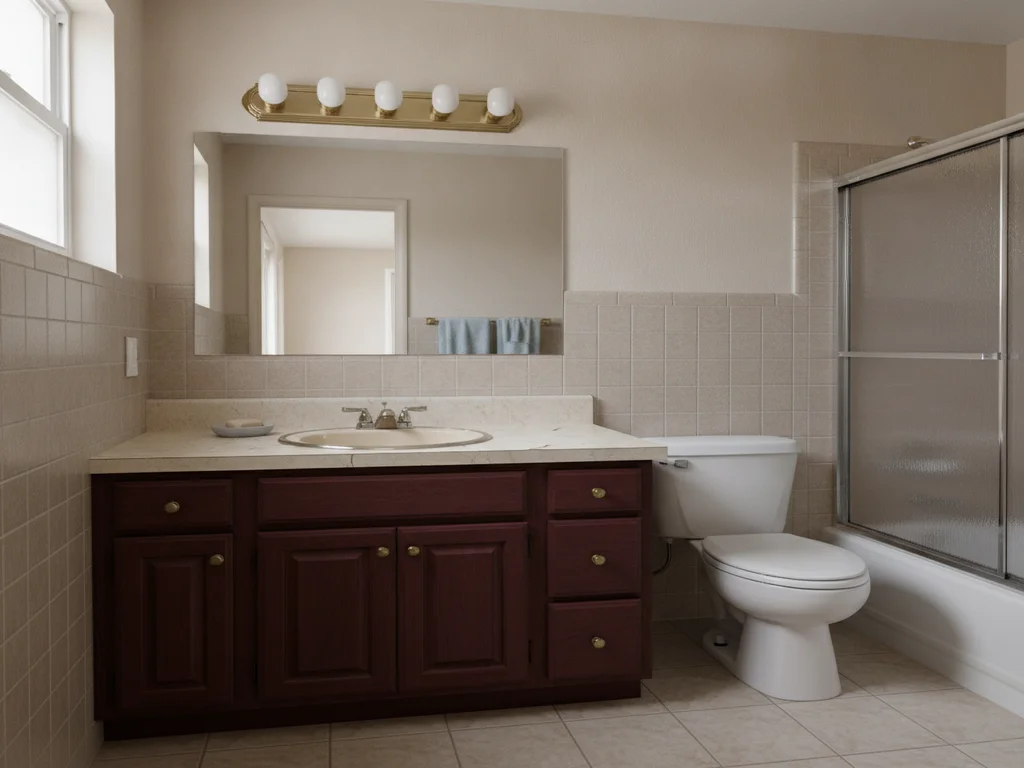
Task lighting is where most builder-grade bathrooms fail, because the default fixture — a single strip light mounted on top of the mirror or centered on the ceiling — lights the room but not the face. Overhead-only light casts hard shadows under the eyebrows, nose, and chin, which is exactly the wrong pattern for shaving, applying makeup, or checking skin.
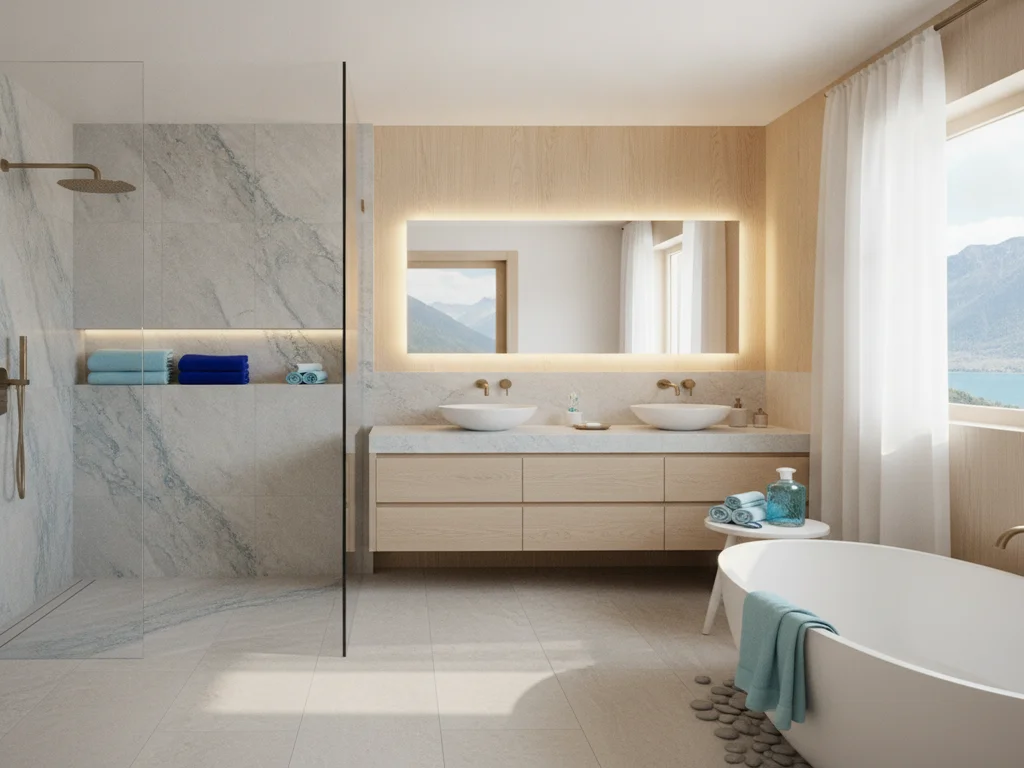
The fix NKBA and lighting designers converge on is vertical, face-height light: sconces mounted on the wall on either side of the mirror at roughly eye level, or a front-lit / edge-lit mirror that puts light directly on the face from the front rather than from above. If only one option is possible, side sconces generally outperform a single top strip because they cross-light the face from two directions and cancel out most of the shadowing.
For a double vanity, that means duplicating the sconce pair on each side rather than sharing one center fixture across two people standing at different points along the counter — a detail worth confirming during electrical rough-in, since running two extra circuits after drywall is far more disruptive than planning for them up front.
A quick face-lighting test
Stand at the vanity and look at yourself in the mirror with only the current lighting on. If you can see a hard shadow line under your brow or nose, the layout is ambient-only or overhead-only — it's missing true task light at face height.
CRI and color temperature: two different specs, both worth checking
Two numbers on a bulb's packaging determine whether vanity light actually helps you see true color and skin tone: Color Rendering Index (CRI) and correlated color temperature (measured in Kelvin). They are frequently confused, and manufacturer reference material is explicit that they're independent: Westinghouse Lighting's CRI education page notes that two bulbs can share the same Kelvin rating and still render color very differently — "a 5000K fluorescent light source could have a CRI of 75, [while] another 5000K fluorescent light source can have a CRI of 90."
CRI is scored 0–100 against natural daylight; per Westinghouse, 80–90 is "regarded as good" and 90+ is "excellent." ENERGY STAR's downlight criteria set the certification floor at Ra ≥ 80 with R9 > 0 (R9 specifically measures how well a source renders saturated reds — a common weak point in cheaper LEDs, and relevant for skin tone at a vanity mirror). For vanity task lighting specifically, most lighting designers recommend going above the ENERGY STAR floor and specifying CRI 90+ bulbs, since accurate color and skin-tone rendering is the entire point of that fixture.
Color temperature is a separate choice about warmth vs. coolness of the light, not its quality. DOE guidance puts "warm" light — matching traditional incandescent bulbs — at about 2700K, with "soft" around 3000K, "neutral" around 3500K, and "cool" light suited to offices and task-heavy spaces at 4100K and above. For a residential vanity, 2700–3000K is the common recommendation because it renders skin tones the way most people expect to see them at home; some designers push to 3500K in a bathroom that reads more clinical or spa-like. Whatever's chosen, DOE's advice to keep color temperature consistent across all fixtures in a room holds here — mixing a 2700K vanity light with 4000K recessed cans reads as visibly mismatched.
| Color temperature | DOE description | Typical bathroom use |
|---|---|---|
| 2700K | Warm — matches incandescent | Vanity task light, relaxed ambient |
| 3000K | Soft | Vanity task light, general ambient |
| 3500K | Neutral | Spa-style or brighter ambient |
| 4100K+ | Cool | Not typically recommended for residential vanities |
Keep all fixtures in the room at the same color temperature — mixing warm and cool light in one bathroom reads as mismatched even if each fixture is fine on its own.

Layer 3: Accent — the layer that makes a bathroom feel finished
Accent lighting doesn't make the room usable; it makes the room feel designed. Common bathroom applications include a toe-kick or under-cabinet LED strip at the vanity for a soft night-light effect, a lit niche in a custom tile shower, backlighting behind a freestanding tub, or a small pendant over a soaking tub as a focal point — a common request in master bathroom retreat projects where the tub is the centerpiece of the room.
Accent light is also the practical answer to the classic middle-of-the-night problem: a dim toe-kick strip on its own switch or motion sensor lights the path to the toilet without flipping on full brightness that wakes everyone up and takes a minute to adjust to.
Wet-rated fixtures and where code actually draws the line
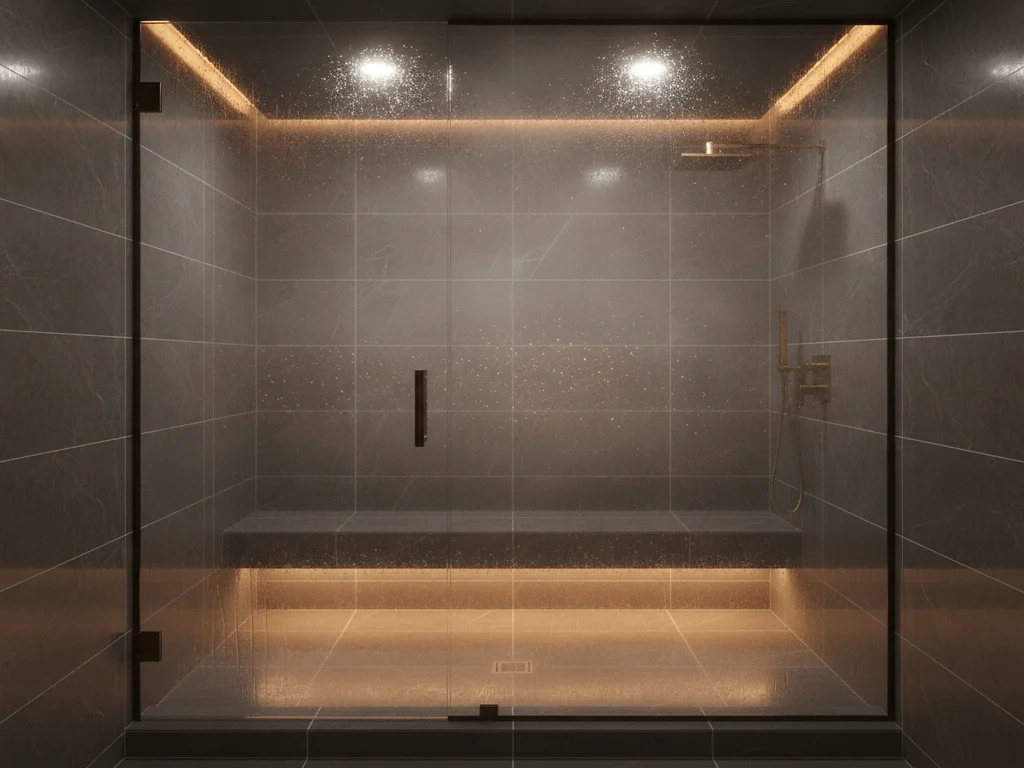
Fixture selection is as much a hardware decision as a lighting one — see our bathroom fixtures and hardware guide for how lighting fits alongside faucets, hooks, and towel bars in a coordinated finish package. Not every bathroom fixture needs the same electrical listing, and getting this wrong is both a code violation and a safety issue. The National Electrical Code, Section 410.10(D), governs bathtub and shower areas specifically: any fixture — recessed can, pendant, track light, or paddle fan — located within a zone measured 3 feet horizontally and 8 feet vertically from the top of the tub rim or shower threshold must be listed suitable for damp locations at minimum, and suitable for wet locations if it's actually subject to shower spray. Cord-connected, chain-, cable-, or cord-suspended fixtures are prohibited inside that zone entirely, regardless of rating.
In practice: a recessed light directly over an open shower or a tub deck needs a wet-location listing, because it sits inside the spray zone. A vanity sconce well outside the 3-foot/8-foot envelope can typically stay dry-rated. A fixture just outside the shower door but within 3 feet of the threshold needs at least a damp-location listing even though it never gets sprayed directly.
Washington adopted the 2026 edition of the National Electrical Code (NFPA 70) into WAC 296-46B, effective December 2025, through the Department of Labor & Industries' electrical rulemaking process — so Clark County electrical inspections are checked against the current NEC, not an older edition. If a remodel is relocating a shower or moving lighting closer to a tub, it's worth confirming fixture ratings against the 3-foot/8-foot zone before purchasing, since a beautiful fixture that isn't wet-rated for its location will fail inspection and need to come back out.
Damp-rated vs. wet-rated — they're not interchangeable
Damp-rated fixtures resist moisture and condensation but aren't built to handle direct water contact. Wet-rated fixtures are sealed to handle direct spray. A wet-rated fixture can go anywhere a damp-rated one can, but not the reverse — when in doubt inside a shower enclosure, spec wet-rated.
Dimming: the cheapest upgrade with the biggest range of use
A bathroom gets used completely differently at 6 a.m. than at 10 p.m., and dimming is the simplest way to make one lighting plan serve both. Full brightness matters for grooming tasks and reading fine print on a medication label; a soft, dimmed setting matters for a relaxed bath or a 2 a.m. trip that shouldn't require full wakefulness.
Not every LED dims smoothly — flicker, buzzing, or a limited dimming range are common with mismatched dimmer/bulb pairings. ENERGY STAR's downlight criteria require that any downlight marketed as dimmable provide continuous dimming from 100% down to at least 20% of light output, without exceeding 24 dBA of audible noise at the lowest setting — a useful spec to check against when selecting both the bulb/fixture and the dimmer switch, since pairing an ENERGY STAR-certified dimmable fixture with a compatible dimmer avoids most of the flicker complaints homeowners run into with mismatched retrofit LED and dimmer combinations.
Where the budget allows, separate dimmers for the ambient and task layers give the most control — full bright vanity sconces for grooming, paired with a dimmed ambient layer for everything else. Motion- or timer-controlled dimming on the accent layer (like a toe-kick strip) is a simple way to get night-safe lighting without a manual switch to remember.
A practical bathroom lighting checklist
- Plan three layers — ambient, task, accent — rather than one ceiling fixture, per NKBA's three-category framework.
- Mount vanity task light at eye height on both sides of the mirror (or use a front-lit mirror) to avoid overhead shadowing.
- Specify CRI 90+ for vanity task lighting; ENERGY STAR's own floor is Ra ≥ 80 with R9 > 0.
- Match color temperature across all fixtures in the room — 2700–3000K is the common residential vanity choice per DOE guidance.
- Rate every fixture correctly against NEC 410.10(D)'s 3-ft horizontal / 8-ft vertical shower/tub zone — wet-rated inside spray range, damp-rated at minimum within the zone.
- Put ambient and task layers on separate dimmers where the budget allows, and confirm dimmer/bulb compatibility to avoid flicker.
- Bring in daylight where privacy allows — a window, skylight, or frosted glass over a tub or shower does real work in a marine climate.
Ready to plan your Clark County bathroom?
Licensed & insured · 3-year workmanship warranty
Frequently asked questions
- How many types of lighting does a bathroom need?
- NKBA frames bathroom lighting as three layers: ambient (overall room light), task (shadow-free light for grooming, typically at the vanity), and accent (mood and architectural highlight lighting). Most builder-grade bathrooms only have ambient light, which is why vanity tasks like shaving or makeup often feel poorly lit even in a bright room.
- What CRI and color temperature is best for a bathroom vanity?
- Aim for CRI 90 or higher for accurate skin-tone and color rendering at the mirror — ENERGY STAR's certification floor for downlights is Ra ≥ 80 with R9 > 0, but vanity task light benefits from going higher. For color temperature, 2700–3000K (DOE's "warm" to "soft" range) is the common residential choice; keep every fixture in the room at the same color temperature to avoid a visibly mismatched look.
- Do bathroom light fixtures need to be wet-rated?
- Only fixtures within the zone the National Electrical Code defines in Section 410.10(D): 3 feet horizontally and 8 feet vertically from the top of a tub rim or shower threshold. Fixtures inside that zone need at least a damp-location listing, and any fixture actually subject to shower spray needs a wet-location listing. Fixtures well outside that zone, like most vanity sconces, can typically stay dry-rated.
- Why does my bathroom vanity light cast shadows on my face?
- Almost always because the light source is overhead-only — a ceiling fixture or a strip mounted on top of the mirror lights the top of the head and casts shadows under the brow, nose, and chin. The fix is vertical, face-height light: sconces on both sides of the mirror at roughly eye level, or a front-lit mirror that puts light directly on the face.
- Is it worth putting bathroom lighting on a dimmer?
- Yes — a bathroom is used very differently at 6 a.m. than at 10 p.m., and dimming lets one lighting plan serve both without installing separate fixtures. ENERGY STAR requires downlights marketed as dimmable to dim continuously from 100% down to at least 20% of output without excess noise; pairing a compatible dimmer with a certified fixture is the main way to avoid LED flicker.
Sources
- NKBA — Lighting in Kitchens and Baths
- U.S. DOE — Purchasing Energy-Efficient Light Bulbs
- ENERGY STAR — Downlights Key Product Criteria
- Westinghouse Lighting — Color Rendering Index (CRI) Explained
- up.codes — NEC Section 410.10, Luminaires in Specific Locations
- Washington State Legislature — WAC 296-46B (Electrical Safety Standards)
Claims and figures are drawn from the sources above and provided for general guidance; your project may vary. Photography is illustrative of design concepts. For a fixed price on your specific bathroom, request a free estimate.