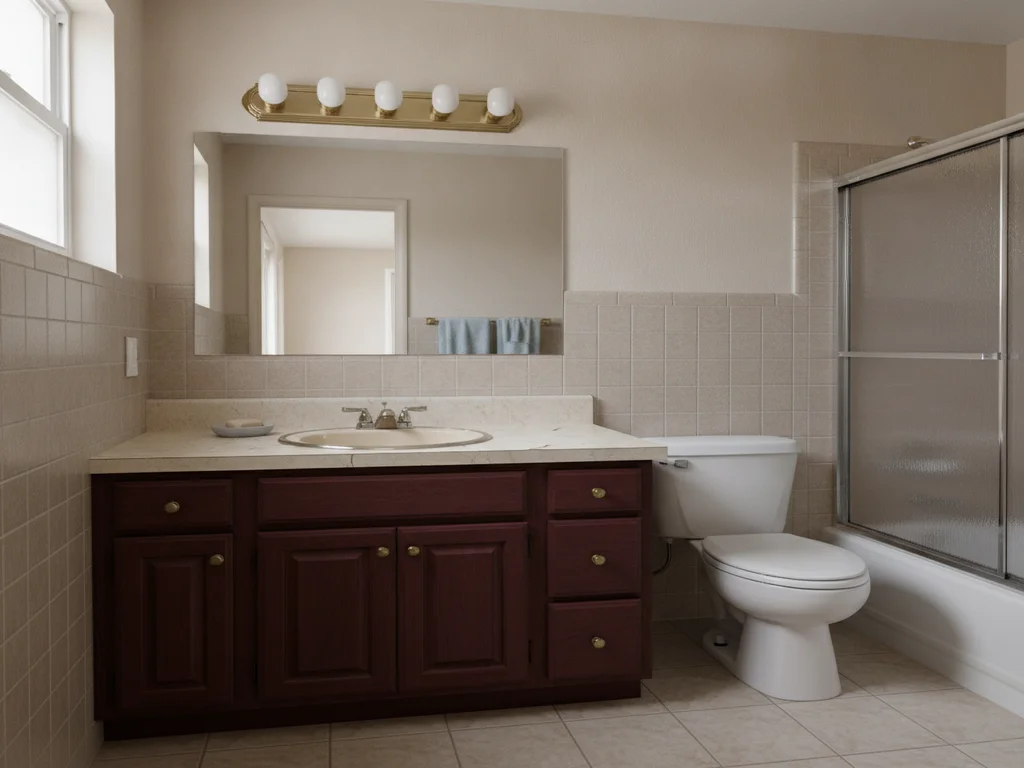
Updated July 12, 2026 · 11 min read
The short answer
A vanity mirror should be sized to the sink centerline, with its bottom edge no more than 40" above the floor per NKBA guidance, and hung close enough to the mirror's own width above the counter to avoid an awkward gap. Backlit and defogger-equipped mirrors need dedicated GFCI-protected 120V circuits per NEC 210.8(A)(1) — a wiring detail that matters most in the Pacific Northwest's humid, low-light winters.
Key takeaways
- NKBA guidance puts the bottom edge of a vanity mirror no more than 40" above the floor, sized to the sink or sink pair it serves rather than the whole vanity run.
- Vertical illuminance on the face — not just ambient room light — is what actually makes grooming tasks easier; industry lighting guidance (IES RP-11) targets light aimed at the face and neck from the sides, not from directly overhead.
- Any mirror with integrated lighting or a defogger pad draws real current and needs its own GFCI-protected circuit under NEC 210.8(A)(1), which Washington enforces through WAC 296-46B — this is an electrical planning item, not an afterthought.
- Defogger pads are inexpensive and low-wattage (roughly 20-60W for common vanity-mirror sizes) but only work if sized to the mirror and wired to a switch that runs before showering, not after — the pad needs lead time to warm the glass above dew point.
- A medicine cabinet trades some mirror size for real storage; in the Camas/Vancouver area's smaller original bathrooms, a shallow recessed medicine cabinet often outperforms a surface-mounted one because it does not eat into an already-tight vanity approach clearance.
- In a small bathroom, one large mirror sized to the full vanity width — rather than a single small square mirror — does more to make the room feel bigger than almost any other single design choice.
Why the mirror deserves its own planning step
Every other bathroom fixture gets used for minutes a day. The mirror gets used every time someone walks in — shaving, makeup, checking a kid's teeth-brushing, straightening a tie before work in Vancouver. That frequency of use is exactly why mirror decisions are worth planning deliberately instead of picking whatever fits the leftover wall space above the vanity after everything else is chosen.
This guide works through the decisions in order: sizing and height against real placement guidelines, framed vs. frameless, backlit and LED mirrors and the electrical work they require, anti-fog and defogger specs for our humid Pacific Northwest climate, medicine cabinets, and small-bathroom mirror strategy. For the fixtures around the mirror — faucets, lighting, hardware finishes — see our bathroom fixtures and hardware guide.
Sizing and placement: the numbers behind a mirror that looks right
A mirror that's too small for its vanity, or hung too high, is one of the more common bathroom design mistakes — and it's avoidable with a few real numbers. NKBA's Bath Planning Guidelines recommend the bottom edge of a vanity mirror sit no more than 40" above the finished floor, which keeps the reflecting surface usable for most adult heights and for kids standing at a step stool. NKBA also recommends vanity task lighting at eye level, roughly 65"-70" above the floor, positioned beside the mirror rather than only above it — a detail that drives mirror width as much as it drives fixture choice.
Width matters as much as height. A mirror sized close to the full width of the vanity or sink run — leaving only a few inches of wall visible on each side — reads as intentional; a small mirror centered over a wide vanity reads as an afterthought. For a double vanity, that usually means either one wide mirror spanning both sinks or two mirrors, each centered on its own sink, with a consistent gap between them rather than an offset one.
The gap between the top of the faucet or backsplash and the bottom of the mirror is a smaller number but still worth setting on purpose — 4"-6" is typical, enough to clear a soap dispenser or tall bottle without leaving a visually awkward void. None of these are hard code requirements; they are professional planning guidance, which is exactly why they're worth following even though nothing forces the issue.
Framed vs. frameless
A frameless mirror — polished or beveled edge, no visible border — reads clean and contemporary and tends to make a bathroom feel larger, since there's no dark frame breaking up the wall. It's also usually the lower-cost option for a given size, since there's no additional material or labor for a frame.
A framed mirror adds a defined edge that can tie into cabinet hardware, light fixture finish, or a specific design style — a wood frame for a warmer, traditional look, or a slim black metal frame for a more industrial or modern one. The tradeoff is that a frame effectively shrinks the reflecting surface for a given wall opening, and in a smaller Camas or Washougal bathroom, that reduction is worth weighing against the space-making benefit of a larger unbroken reflective area.
There's no universally correct choice here — it's a style call layered on top of the sizing guidance above. What matters is deciding intentionally rather than defaulting to whatever the vanity's manufacturer bundles with it.
Backlit and LED mirrors: what the electrical actually requires
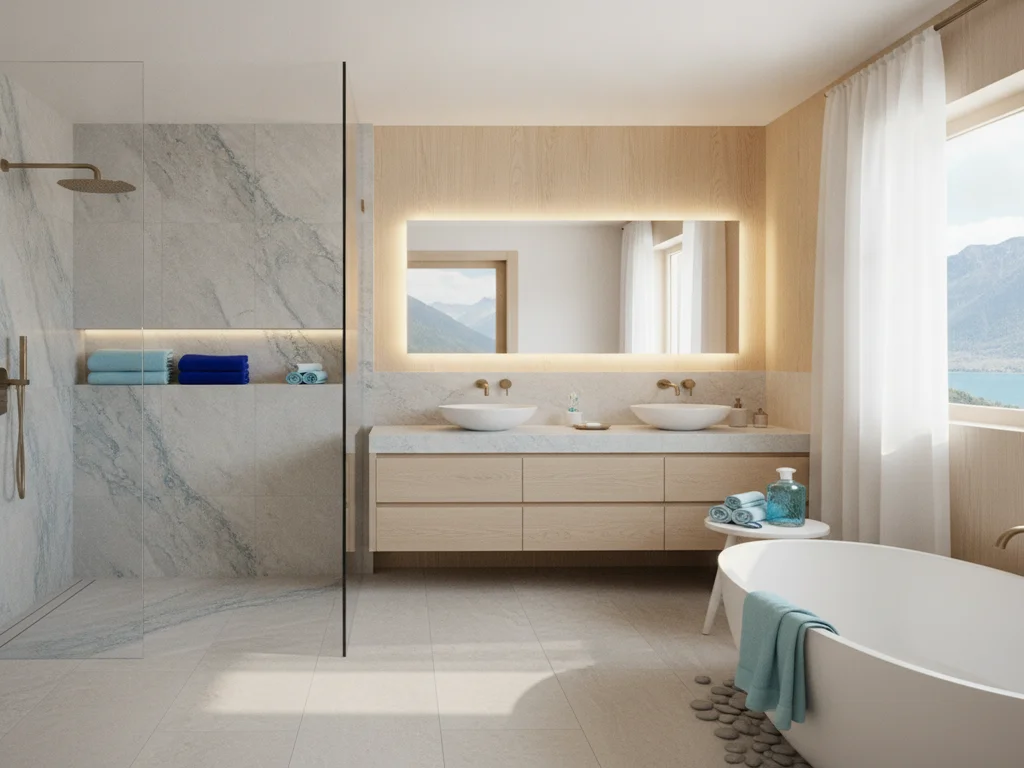
Backlit and LED-integrated mirrors have gone from a luxury niche to a mainstream upgrade, and for good reason — light that wraps the mirror edge or washes the wall behind it softens the harsh shadows a single overhead fixture creates. Industry lighting guidance (IES RP-11, the residential lighting recommended practice) is specific about the goal: fixtures should aim light at the face, head, and neck from the sides, out of the direct line of sight, rather than relying on ceiling-mounted downlights that cast shadows under the brow and chin. A backlit mirror can help with that, though most lighting designers still pair it with a second task-light source rather than relying on backlighting alone.
The part that gets overlooked is the electrical planning. A lit mirror is not a passive fixture — it draws real current, and it needs to land on its own circuit, correctly protected. NEC 210.8(A)(1) requires ground-fault circuit-interrupter (GFCI) protection for receptacles in dwelling-unit bathrooms, and Washington enforces the National Electrical Code through WAC 296-46B, the state electrical safety code. Some lit mirrors hardwire into the lighting circuit rather than plugging into a receptacle, which shifts the code question slightly but not the underlying point: this is a licensed-electrician wiring decision, not a plug-and-play accessory, and it needs to be settled during rough-in — not after tile is set.
If a lit mirror is part of the plan, loop in your electrician (or your full bathroom remodel team) before the walls close up. Retrofitting a dedicated circuit and box location after drywall and tile are in is dramatically more disruptive than planning for it up front.
Anti-fog mirrors and defoggers: solving the humid-PNW problem
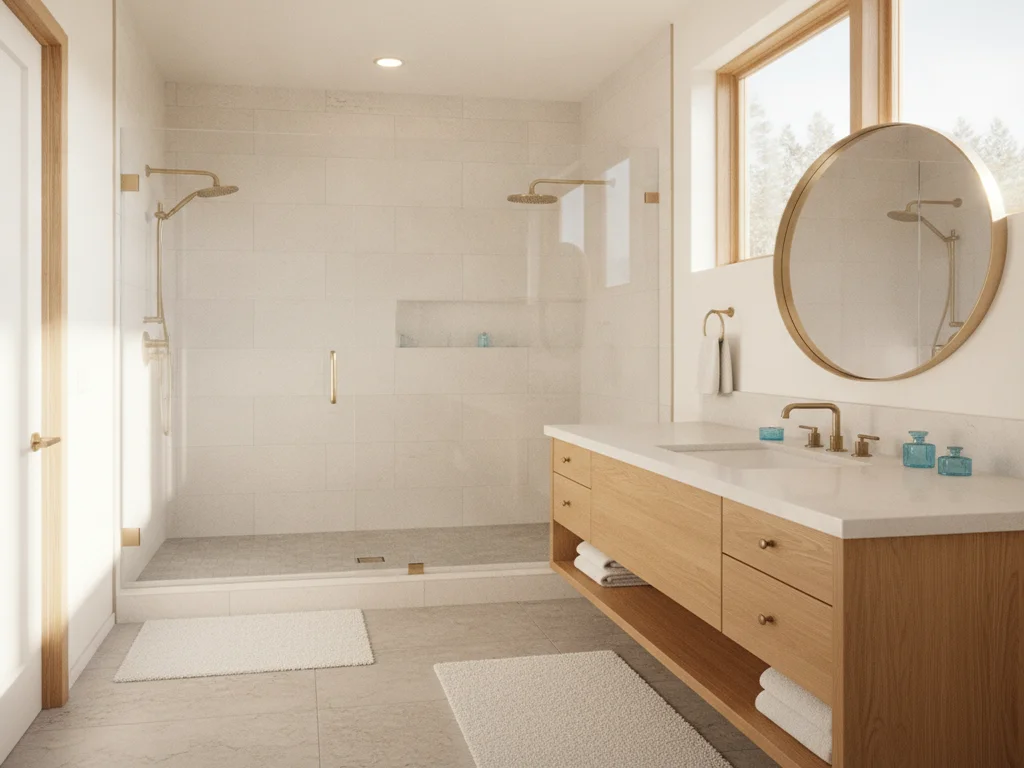
Fog on a mirror is condensation — warm, moisture-laden shower air hitting glass that's colder than the room's dew point. In Camas and Vancouver's marine climate, with long humid winters and showers that run hot for months at a time, that's a near-daily annoyance rather than an occasional one. Two products solve it: a mirror defogger pad, and a mirror with one already built in.
A defogger pad is a thin resistive heating element that adheres to the back of the mirror and keeps the glass warm enough to stay above the dew point, so moisture never condenses on it in the first place. Real manufacturer specs give a sense of scale: WarmlyYours' FFM-1218 pad, sized for a 12"x18" mirror, draws about 23 watts on a 120V lighting circuit and holds roughly 104°F at the glass — modest power draw, but still a load that needs to be accounted for on whatever circuit it shares. Larger mirrors need proportionally larger pads; oversizing the pad relative to the mirror wastes energy, undersizing it leaves cold edges that still fog.
The other detail that matters more than the spec sheet: timing. A defogger needs a few minutes of lead time to bring the glass above dew point, so it works best wired to a switch that gets turned on before the shower starts — either manually or via a timer — not one that only comes on with the shower itself. A pad switched on after the mirror has already fogged is playing catch-up instead of preventing the problem.
A defogger treats the mirror; it doesn't treat the room. The Home Ventilating Institute recommends sizing a bath exhaust fan to at least 1 CFM per square foot of floor area (minimum 50 CFM for bathrooms under 50 sq ft, with added capacity for a separate shower or tub), and a correctly sized, HVI-certified fan pulls the humid air out before it saturates every surface — mirror included. In a marine climate, a defogger pad and a properly sized exhaust fan are complementary fixes, not substitutes for each other; see our bathroom ventilation CFM guide for sizing a fan to the room.
Anti-fog coatings vs. defogger pads
Hydrophilic anti-fog coatings and sprays work by spreading condensation into a thin, transparent sheet instead of visible droplets — they reduce fogging but don't eliminate the underlying temperature difference the way a heated pad does. For a shower-adjacent vanity mirror used daily, a defogger pad is the more durable, lower-maintenance fix; a coating is a reasonable lower-cost option for a mirror that only fogs occasionally.
Medicine cabinet mirrors
A medicine cabinet does two jobs at once — mirror and storage — which is exactly why it remains a practical default, especially in the smaller original bathrooms common in Camas and Washougal's older housing stock. A recessed medicine cabinet, set into the wall cavity between studs, keeps the front face flush and doesn't add depth the room can't spare; a surface-mounted cabinet is easier to retrofit into an existing wall (no cavity work) but sits proud of the wall by a few inches, which matters in a tight vanity approach clearance.
The tradeoff against a plain mirror is straightforward: a medicine cabinet's door seams and hinges interrupt the reflecting surface in a way a single sheet of mirror glass doesn't, and in a small bathroom that visual break can work against the space-enlarging effect a large uninterrupted mirror provides. Where storage is genuinely tight — a single-bath household with more than one person getting ready in the morning — that tradeoff is usually worth it anyway.
Small-bath mirror strategy
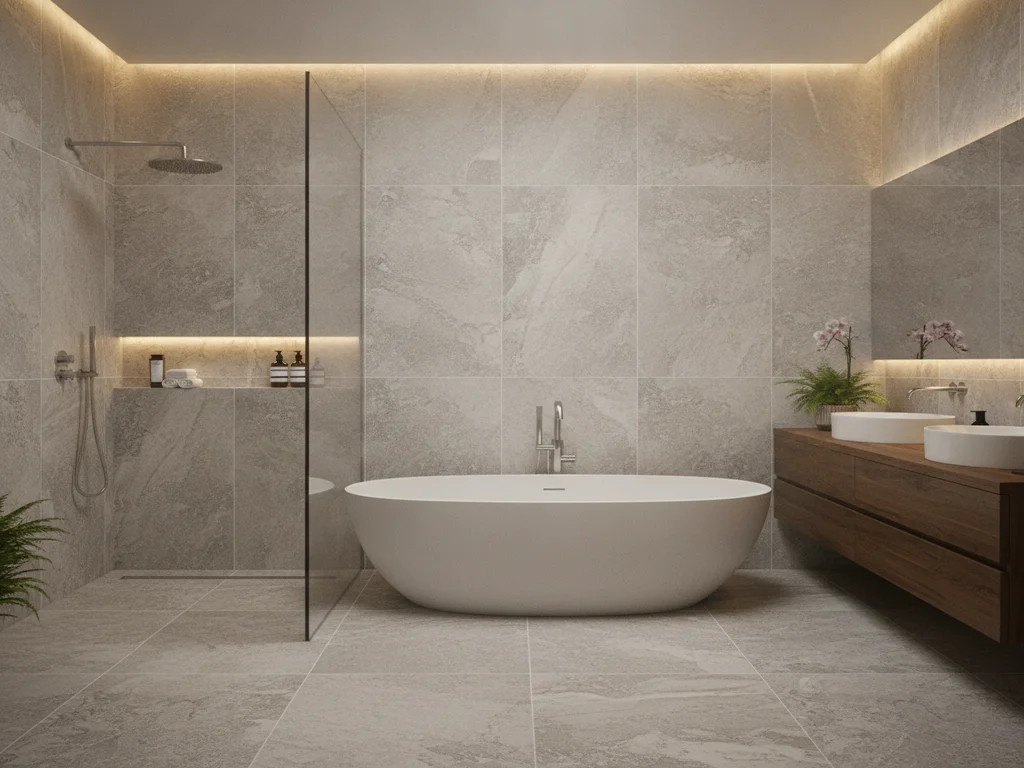
In a compact bathroom, the mirror is one of the highest-leverage, lowest-cost moves available. A single large mirror — sized close to the vanity's full width, extending up near the light fixtures — reflects more of the room and more of whatever natural light the room has, which reads as significantly more spacious than the same wall fitted with a small centered mirror and blank tile on either side.
Positioning the mirror to reflect a window, where the layout allows it, doubles the perceived light source without adding a single fixture. Where a window isn't an option, pairing a full-width mirror with side-mounted task lighting (per the placement guidance above) gets most of the same visual benefit. For more small-bathroom-specific strategy beyond the mirror — vanity choice, shower footprint, storage — see our marine climate bathroom moisture control guide for how humidity control and small-footprint design work together in this climate.
Bringing it together in a remodel
None of these decisions happen in isolation from the rest of the room. Mirror width depends on vanity width; lit-mirror wiring depends on where the electrician runs circuits during rough-in; defogger timing depends on how the bath fan and lighting switches are laid out. That's the same reason a mirror upgrade is usually planned alongside the vanity and lighting in a full bathroom remodel rather than swapped in on its own after the fact — and it's especially true in a master bathroom retreat, where a wide backlit mirror over a double vanity is often one of the first things a homeowner asks for.
For Vancouver-area homes working through the same decisions, our full bathroom remodeling services in Vancouver cover the same planning process. And because every mirror choice in this guide interacts with the Pacific Northwest's humidity, it's worth reading alongside our broader guide to marine climate bathroom moisture control before finalizing a plan.
Ready to plan your Clark County bathroom?
Licensed & insured · 3-year workmanship warranty
Frequently asked questions
- How high should a bathroom mirror be hung above the vanity?
- NKBA guidance puts the bottom edge of the mirror no more than 40" above the finished floor, with task lighting positioned beside the mirror at roughly 65"-70" above the floor. Leave about 4"-6" between the top of the faucet or backsplash and the bottom of the mirror.
- Do backlit or LED mirrors need special wiring?
- Yes. Any mirror with integrated lighting draws current and needs to land on a properly protected circuit — NEC 210.8(A)(1) requires GFCI protection for bathroom receptacles in dwelling units, enforced in Washington through WAC 296-46B. Some lit mirrors hardwire directly into a lighting circuit instead of plugging in, but either way this is a licensed-electrician decision that needs to be planned before rough-in, not added afterward.
- Do anti-fog mirror defoggers use a lot of electricity?
- No — manufacturer specs for common vanity-mirror-sized pads run roughly 20-60 watts, comparable to a single incandescent bulb. The bigger factor is timing: the pad needs a few minutes of lead time before a hot shower to bring the glass above dew point, so it works best on a switch turned on before showering rather than one tied only to the shower itself.
- Is a medicine cabinet or a plain mirror better for a small bathroom?
- It depends on what the household needs more: storage or visual space. A medicine cabinet adds real storage but its door seams interrupt the reflective surface. A single large plain mirror, sized to the vanity's full width, does more to make a small room feel bigger. In a tight single-bath household, the storage tradeoff is often worth it anyway.
- Should a mirror be framed or frameless?
- Both are legitimate choices — it's a style decision, not a functional one. Frameless mirrors tend to read larger and cost less for a given size, since there's no additional frame material or labor. A framed mirror can tie into cabinet hardware or lighting finish for a more coordinated look, at the cost of slightly less reflective surface for the same wall opening.
Sources
- NKBA — Bath Planning Guidelines with Access Standards
- IES — RP-11, Lighting for Interior and Exterior Residential Environments
- NFPA 70 (NEC) 210.8(A)(1) — GFCI Protection for Personnel, via UpCodes
- Washington State — WAC 296-46B, Electrical Safety Standards
- WarmlyYours — FFM-1218 Mirror Defogger Pad Specifications
- Home Ventilating Institute — Bathroom Exhaust Fans Guidance
Claims and figures are drawn from the sources above and provided for general guidance; your project may vary. Photography is illustrative of design concepts. For a fixed price on your specific bathroom, request a free estimate.