
Updated July 12, 2026 · 10 min read
The short answer
A bidet seat retrofits onto your existing toilet; a standalone bidet is a separate fixture next to it; an integrated smart toilet replaces the toilet entirely. Electric models all need a dedicated 120V GFCI-protected outlet within a few feet of the toilet and a compatible cold-water line — manufacturer specs (TOTO, Kohler) and NEC-derived code both require it. Non-electric bidet attachments need only water.
Key takeaways
- Three product tiers, not one: a bidet seat replaces just the toilet seat and works with your existing bowl; a standalone bidet is a second, separate fixture; an integrated smart toilet is a single unit that replaces the toilet outright.
- Any electric model — heated seat, warm water, dryer, night light — needs its own outlet. Kohler specifies a dedicated 120V, 15A, GFCI-protected, grounded outlet within 32 inches of the toilet; TOTO specifies a 120V GFCI outlet within about 3 feet, typically mounted on the wall behind the bowl.
- That outlet has to be GFCI-protected as a matter of code, not brand preference: bathroom receptacles fall under GFCI requirements built into the National Electrical Code, and Washington amends its own electrical code (WAC 296-46B) around the same NEC base, per the U.S. Consumer Product Safety Commission and the Washington State Legislature.
- Water side is simpler but not optional: electric bidet seats connect to the cold-water supply line (Kohler specs 20–80 psi) through a T-valve at the existing toilet shutoff, and integrated smart toilets add their own supply and drain connection like any toilet install.
- Comfort-height and clearance numbers are standardized, not a marketing term: the U.S. Access Board sets ADA seat height at 17–19 inches to the top of the seat and requires 60 inches of side clearance and 56 inches of rear clearance for an accessible water closet — worth checking before ordering a bulkier smart-toilet unit into a tight footprint.
- A WaterSense-labeled toilet caps flush volume at 1.28 gallons per flush versus the 1.6 gpf federal maximum, per EPA — a spec that still applies to the toilet portion of an integrated smart toilet, so efficiency and smart features are not mutually exclusive.
Three different products get called "bidet" — know which one you are buying
"Bidet" gets used loosely for three genuinely different products, and the electrical and plumbing requirements differ across all three. A bidet seat replaces only the seat on your existing toilet bowl — the bowl stays, the seat adds spray and (on electric models) heat, dryer, and wash functions. A standalone bidet is a separate fixture installed next to the toilet, the traditional European layout, which needs its own water supply and drain the same way a second sink would. An integrated smart toilet — TOTO's Neorest or Kohler's Numi are the well-known examples — replaces the toilet bowl entirely with a single unit that combines the flush mechanism and the bidet functions.
The distinction matters because it decides what has to be true about your bathroom before you order one. A basic non-electric bidet attachment needs only a water connection and can often go in without an electrician. Anything electric — which is most bidet seats and every integrated smart toilet on the market — needs a code-compliant outlet in addition to water. For the broader fixture-selection picture beyond bidets, see our bathroom fixtures & hardware guide.
Electrical: the GFCI outlet is not optional, and manufacturers are specific about where
Every electric bidet seat and integrated smart toilet on the market needs a dedicated, grounded, GFCI-protected 120V outlet — not a shared circuit, not a non-GFCI outlet, and not an extension cord run from another room. This isn't just manufacturer caution: bathroom receptacles fall under GFCI protection requirements that trace back to the National Electrical Code, and the U.S. Consumer Product Safety Commission notes that new homes built to the National Electrical Code require GFCI protection for bathroom outlets specifically because of the shock risk near water. Washington administers its own electrical code, WAC 296-46B, which is built on the same NEC base and separately requires GFCI protection for fixed electrical equipment within 5 feet of a tub's top edge, per the Washington State Legislature.
Manufacturer specs get more precise about placement. Kohler's installation instructions call for a dedicated 120V, 15A, GFCI-protected, properly grounded outlet within 32 inches of the toilet, and explicitly warn against removing the grounding pin or defeating the ground with an adapter. TOTO specifies a 120V GFCI outlet within about 3 feet of the toilet, and recommends mounting it on the wall behind the bowl since Washlet power cords run roughly 4 feet and exit from the seat's left side — worth flagging to your electrician before rough-in, not after tile is set.
If your existing bathroom doesn't already have an outlet within reach of the toilet, adding one is an electrical-permit item, not a DIY afterthought — plan it into the same scope as a full bathroom remodel rather than as a change order mid-project.
Don't rely on an extension cord as the fix
Kohler's own instructions allow an extension cord only as a narrow exception — 12-gauge, grounded, SJ-rated, 25 feet maximum, plugged into a GFCI outlet — not as a routine way to reach a toilet that's far from any outlet. If the toilet is far from power, that's a signal to add a proper outlet, not to cord around the problem.
Water supply: simpler, but still a real connection
Both bidet seats and integrated smart toilets connect to the cold-water line, typically through a T-valve spliced into the existing toilet supply line so the seat and the tank share one shutoff. Kohler's spec calls for supply pressure between 20 and 80 psi, and notes that a connection to a potable water system needs backflow protection. Most homes in Camas and Vancouver are well within that pressure range on municipal supply, but older galvanized supply lines or unusually low well pressure are worth checking before ordering a unit with a fixed pressure spec.
A standalone bidet, being a second fixture, needs its own supply line and drain the way any additional plumbing fixture would — which is a bigger scope item than a seat retrofit and typically only makes sense during a full remodel where the floor is already open. Water quality is a separate consideration from pressure: see our guide on water quality and your Camas bathroom if hard water or mineral buildup is a concern for a fixture with internal spray nozzles.
Comfort height and clearance: the numbers are standardized, not marketing language
"Comfort height" gets used as a sales term, but the underlying dimensions are set by accessibility standards, not by any one brand. The U.S. Access Board sets the ADA seat height for an accessible water closet at 17 to 19 inches measured to the top of the seat — taller than the roughly 15-inch height of older standard toilets, which is why "comfort height" and "ADA height" often land in the same range even when a product isn't formally ADA-rated.
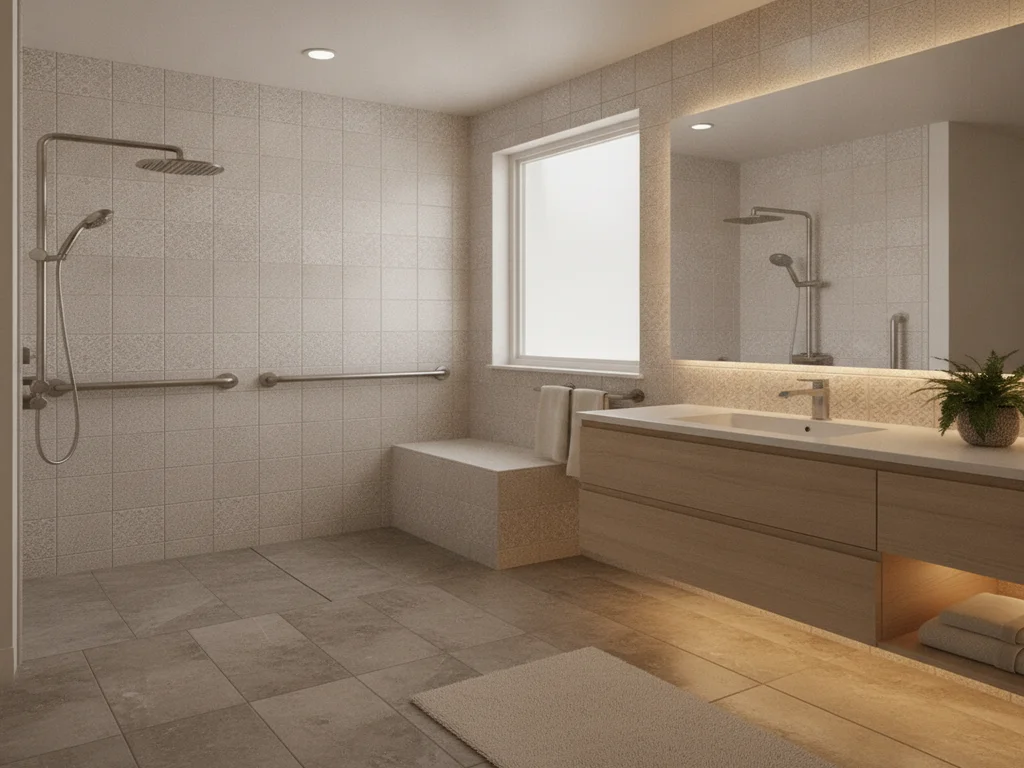
Clearance is the other half of the equation, and it's easy to overlook with a bulkier integrated smart toilet, which can run larger than a standard bowl. The Access Board specifies a minimum of 60 inches of clearance measured from the side wall and 56 inches from the rear wall for an accessible water closet, with the fixture's centerline set 16 to 18 inches from the side wall. Those numbers are written for code-required accessible spaces, but they're a useful sanity check in any tight powder room or hall bath before ordering a larger unit. If accessibility is a project priority beyond just seat height, see accessible bathrooms in Camas for how clearance, grab bars, and fixture height get planned together.
| Dimension | Requirement |
|---|---|
| Seat height (top of seat) | 17–19 in. |
| Side clearance | 60 in. minimum |
| Rear clearance | 56 in. minimum |
| Centerline from side wall | 16–18 in. |
Figures apply to ADA-accessible water closets under the 2010 ADA Standards as summarized by the U.S. Access Board; a non-accessible residential installation isn't required to meet these, but they're a useful reference for comfort-height and clearance planning either way.
Efficiency: a smart toilet is still a toilet, and gpf still applies
Bidet functions don't exempt a toilet from flow-rate standards. Every toilet sold in the U.S. has to meet a federal maximum of 1.6 gallons per flush, and a WaterSense-labeled toilet — including several integrated smart-toilet models — flushes at 1.28 gpf or less while still passing an independent waste-removal performance test, per EPA. That's worth checking on the spec sheet of any integrated unit you're considering; the bidet features and the flush efficiency are two separate line items, and a premium smart toilet isn't automatically WaterSense-rated just because it's expensive. For the full breakdown of federal versus WaterSense standards across toilets, showerheads, and faucets, see our water-efficient bathroom / WaterSense guide.
A bidet seat retrofit doesn't change your existing toilet's flush volume at all — it only adds the wash and dry functions — so if flush efficiency matters to the project, that's a separate toilet-replacement decision, not something a seat upgrade resolves.
Cleaning and upkeep: what the added parts actually require
The tradeoff for the added functions is a few more parts to maintain. Electric bidet seats and integrated units typically have a self-cleaning wand mode that rinses the nozzle before and after each use, but the nozzle and the seat's water reservoir still benefit from periodic manual cleaning with a mild, non-abrasive cleaner — manufacturer manuals generally warn against bleach or abrasive pads directly on the nozzle and control housing, since they can degrade seals over time. Filters, where present, need periodic replacement per the manufacturer's schedule, and the unit should be unplugged before any panel is opened for cleaning, consistent with standard electrical-appliance safety practice.
None of this is a heavy maintenance burden compared to a standard toilet, but it is a genuinely different upkeep routine than a bowl-and-tank-only fixture, and worth factoring in before choosing a heavily featured unit for a low-maintenance guest bath.
Deciding which tier fits your project
A bidet seat is the lowest-cost, lowest-disruption option if your existing toilet and bathroom layout already work — it needs an outlet and a T-valve, not a remodel. A standalone bidet only makes sense with real floor space and, practically, during a full remodel since it's a second fixture with its own rough-in. An integrated smart toilet is the highest-cost option but consolidates the flush and bidet functions into one unit and is worth evaluating against WaterSense efficiency and Access Board clearance figures before ordering, especially in a smaller footprint.
If you're weighing this alongside a full renovation rather than a standalone swap, our full bathroom remodeling in Vancouver, WA service scopes the electrical, water, and fixture-clearance planning together so the outlet, valve, and floor space are settled before the fixture is ordered — not worked around after the fact.
Ready to plan your Clark County bathroom?
Licensed & insured · 3-year workmanship warranty
Frequently asked questions
- Do all bidet seats need an electrician?
- Only electric models — heated seat, warm water, air dryer, night light. A non-electric bidet attachment (cold-water spray only) needs just a water T-valve and no outlet. Any electric model needs a dedicated, GFCI-protected 120V outlet within a few feet of the toilet, per manufacturer specs from Kohler and TOTO — if that outlet doesn't already exist, it's an electrical-permit item.
- Can I plug an electric bidet seat into a regular (non-GFCI) bathroom outlet?
- Bathroom receptacles are required to be GFCI-protected under the National Electrical Code framework that Washington's own electrical code (WAC 296-46B) is built on, per the Washington State Legislature and the U.S. Consumer Product Safety Commission. Manufacturers also specify a GFCI-protected outlet directly in their installation instructions, so this isn't optional either way.
- What is "comfort height" and is it the same as ADA height?
- Comfort height generally refers to a taller toilet seat, in the same 17–19 inch range the U.S. Access Board sets as the ADA standard for accessible water closets, measured to the top of the seat. A toilet marketed as "comfort height" isn't automatically ADA-compliant on its own — clearance, grab bars, and centerline placement matter too — but the seat-height number is usually the same figure.
- Does an integrated smart toilet still qualify as water-efficient?
- It can, but check the spec sheet — bidet functions and flush efficiency are separate features. A WaterSense-labeled toilet, including some integrated smart-toilet models, flushes at 1.28 gallons per flush or less versus the 1.6 gpf federal maximum, per EPA. A smart toilet isn't automatically WaterSense-rated just because it has premium features.
- What water pressure does an electric bidet seat need?
- Kohler's published spec calls for cold-water supply pressure between 20 and 80 psi, connected through a T-valve at the existing toilet shutoff, with backflow protection required if tied into a potable water system. Most municipal supply in the Camas/Vancouver area falls within that range, but it's worth confirming on older plumbing or well systems before ordering.
Sources
- EPA WaterSense — Residential Toilets
- U.S. Access Board — ADA Guide, Chapter 6: Toilet Rooms
- U.S. Consumer Product Safety Commission — GFCI Fact Sheet
- Washington State Legislature — WAC 296-46B-210 (Electrical Safety Standards)
- Kohler — Bidet Seat Installation Instructions
- TOTO USA — Do TOTO WASHLET Bidet Toilet Seats Require Electricity?
Claims and figures are drawn from the sources above and provided for general guidance; your project may vary. Photography is illustrative of design concepts. For a fixed price on your specific bathroom, request a free estimate.